
Chapter 1: The Finger Rustle
Last December, for some reason I can’t recall now, I rustled my fingers together with my right hand, near my right ear. I heard what I expected to hear: a high-pitched rustling sound, sort of like someone shushing me or saying a long “tttthhhhhh” consonant. Then, on a lark, I did the same thing near the left ear, with my left hand… and I couldn’t hear anything.
Nothing. I repeated this several times. It was quite strange to experience this. What to do?
As you can imagine—since I make my living as a choral conductor—hearing is important to me. I had just turned 60 in August. I found myself resisting the notion that I might have hearing loss, especially in just one ear. Genetics were clearly at play; my dad and his mother both had had hearing aids (in both ears), and my sister, who is two years older than me, has had them for a while now. But hearing loss in just one ear? Weird.
I scoured my memory to see what I could recall about my recent history of listening to the world. Have I been missing things? I’ve been fine in rehearsal.
I did recall, however, that for a few months before December, it sometimes had felt like Sandy was mumbling when we were talking at the dining-room table. For breakfast and lunch, I usually sit at a 90-degree angle from Sandy, and sometimes I couldn’t hear her. (She was kind enough to politely tell me that she wasn’t mumbling.) Still, when I did the finger-rustling thing, I realized that, yes, maybe there was something really going on with my hearing on the left side.
One of the gifts of working with so many older adults since 2016 is that issues of aging are front-and-center for me now. Thanks to my experiences with all of you, I have no particular stigma about or negative connotations with hearing aids. If I should need one, so be it.
What to do next? Well, I also feel fortunate in that one of the sopranos in the church choir where Sandy and I have been singing since 2009 – at Holy Nativity Episcopal in Clarendon Hills (next to Hinsdale) – is a Ph.D. audiologist. I called Nancy, and she invited me to come in for a hearing test.
Chapter 2: The Audiologist
I went into the testing booth. It’s the opposite of an echo chamber; there is no sound at all, except for what comes in over the headphones. The test involves listening to a number of words and phrases (or sounds) and noting if I can actually hear them. If I could hear the word or sound, I would click the little button in my left hand. This went on for several minutes.
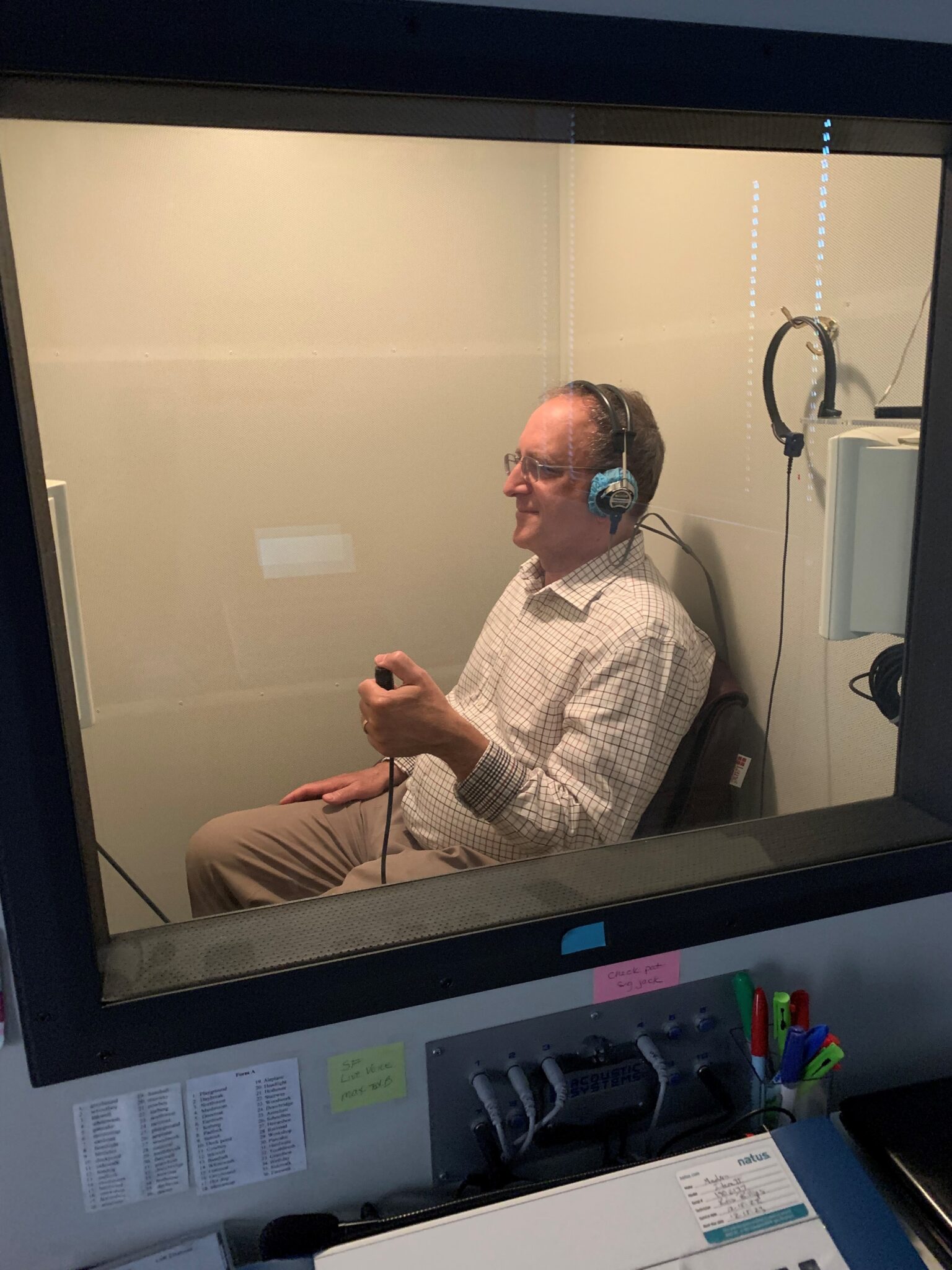
Nancy told me the result right then and there: I have significant hearing loss in my left ear, starting at about 2000 Hz and above. Wow.
What sounds are these, you might wonder? I wondered this myself. According to speech experts, the letters f, s, and th are all examples of consonants spoken at a high pitch that are easy for people with high-frequency hearing loss to miss. These sounds vibrate at around 4,000 to 5,000 Hz, and they make speech sound garbled to someone who has difficulty processing high frequencies. (Most soprano parts for Sounds Good Choir top out at around 880 Hz, or the A above the treble staff.)
Indeed, as she had told me, Sandy was not mumbling. It was my ear that couldn’t take in the consonants that she was saying. I wasn’t making full sense of the words that included those consonants. Who knew?
Now, to have this sort of hearing loss in only one ear is a little unusual. The audiologist recommended that I go to an ENT specialist for a consult, “to make sure that it was just hearing loss and not a brain tumor.” Yikes! (Nancy reassured me that it is only a brain tumor in a very small percentage of cases and that I was likely to be just fine.)
Chapter 3: The ENT
At the ENT’s office, the physician was a very good listener. He asked if there were any events that I could recall, which might have caused hearing loss only one on side. I asked, “Could going to a Paul McCartney concert in 2010 do that?” He laughed and said it couldn’t.
The ENT explained three things that could be the cause of my hearing loss. One is standard aging-related deterioration (for which one gets a hearing aid); one is a sort of hiccup between the inner ear and the brain (for which surgery might be needed); and one is brain cancer (let’s hope it’s not that). To rule out brain cancer, he recommended an MRI. This was starting to sound like a never-ending cascade of medical appointments, and I have avoided spending much time in the medical system. However, I had my eye on the long game, which was trying to see if I could restore some hearing in my left ear. I’m a musician, after all, and I need to hear my wife at the dinner table!
Chapter 4: The MRI
A week later, I drove to Naperville for the MRI. I had had to shop it around, because the prices of MRIs vary widely and my insurance wasn’t in-network at the hospital just down the street. This procedure was a loud and intense half-hour of sounds, vibrations, and all sorts of other sensory stimuli of an ilk that I had never experienced before (except, perhaps, for the much briefer “Mission: Space” ride at Disney World 20 years ago, when my daughter was nine… and about which Sandy and Laura both still tease me because I emerged from that ride white as a ghost). While lying on my back for the MRI, I practiced mindful breathing the whole time, so that I wouldn’t be too nervous. It worked.
The MRI results came back totally clean: no brain tumor! Wahoo! So it was back to the audiologist to get fitted for a hearing aid.
Chapter 5: The Hearing Aid
I don’t have much of a hearing-aid benefit from my health insurance. I decided to pay a little extra and get the hearing aid from my audiologist, instead of from Costco, because the audiologist’s price includes an unlimited number of tweaks and follow-up visits. Being slightly fussy about my hearing, I wanted that security blanket and more of a high-service arrangement.
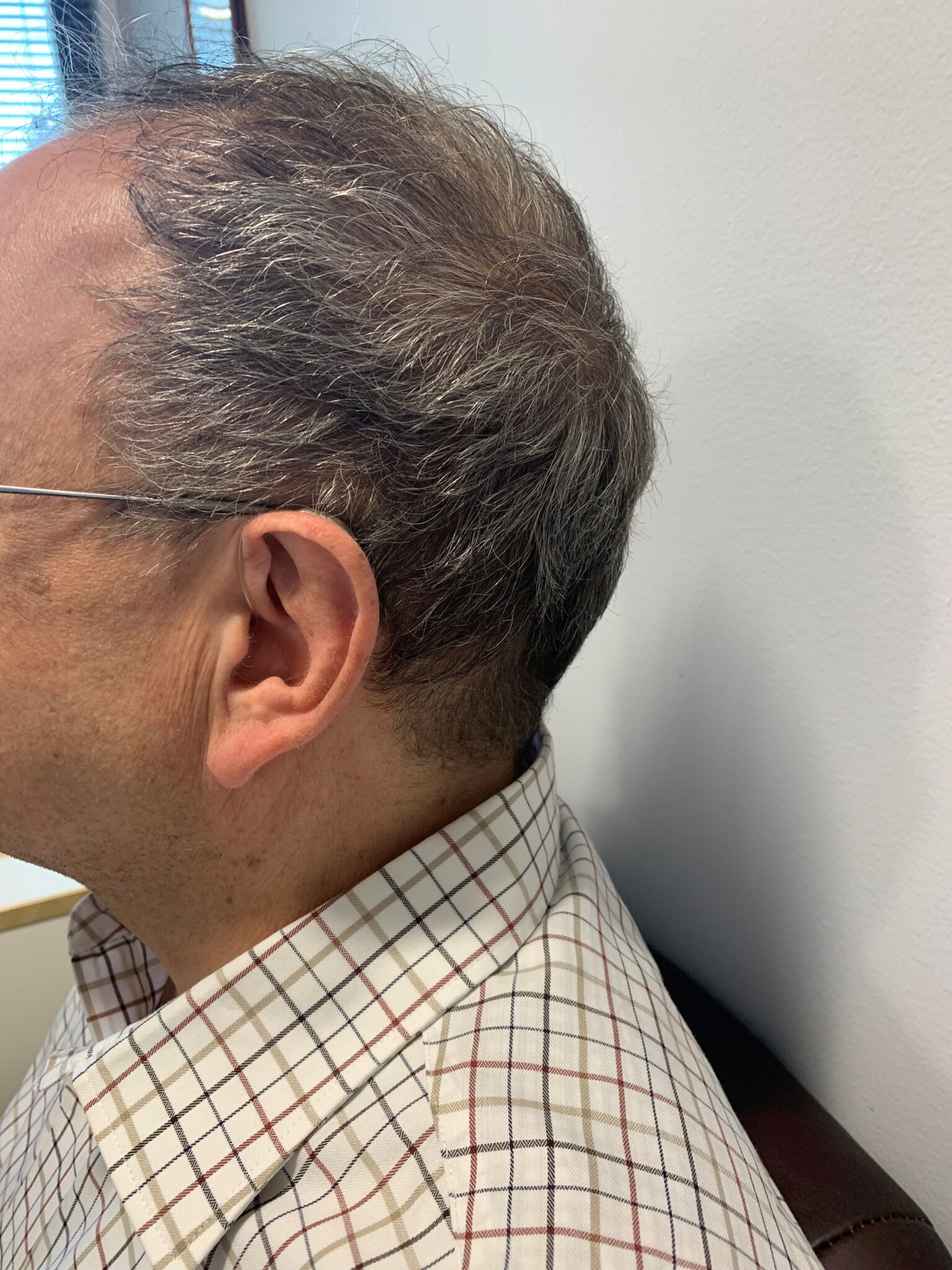
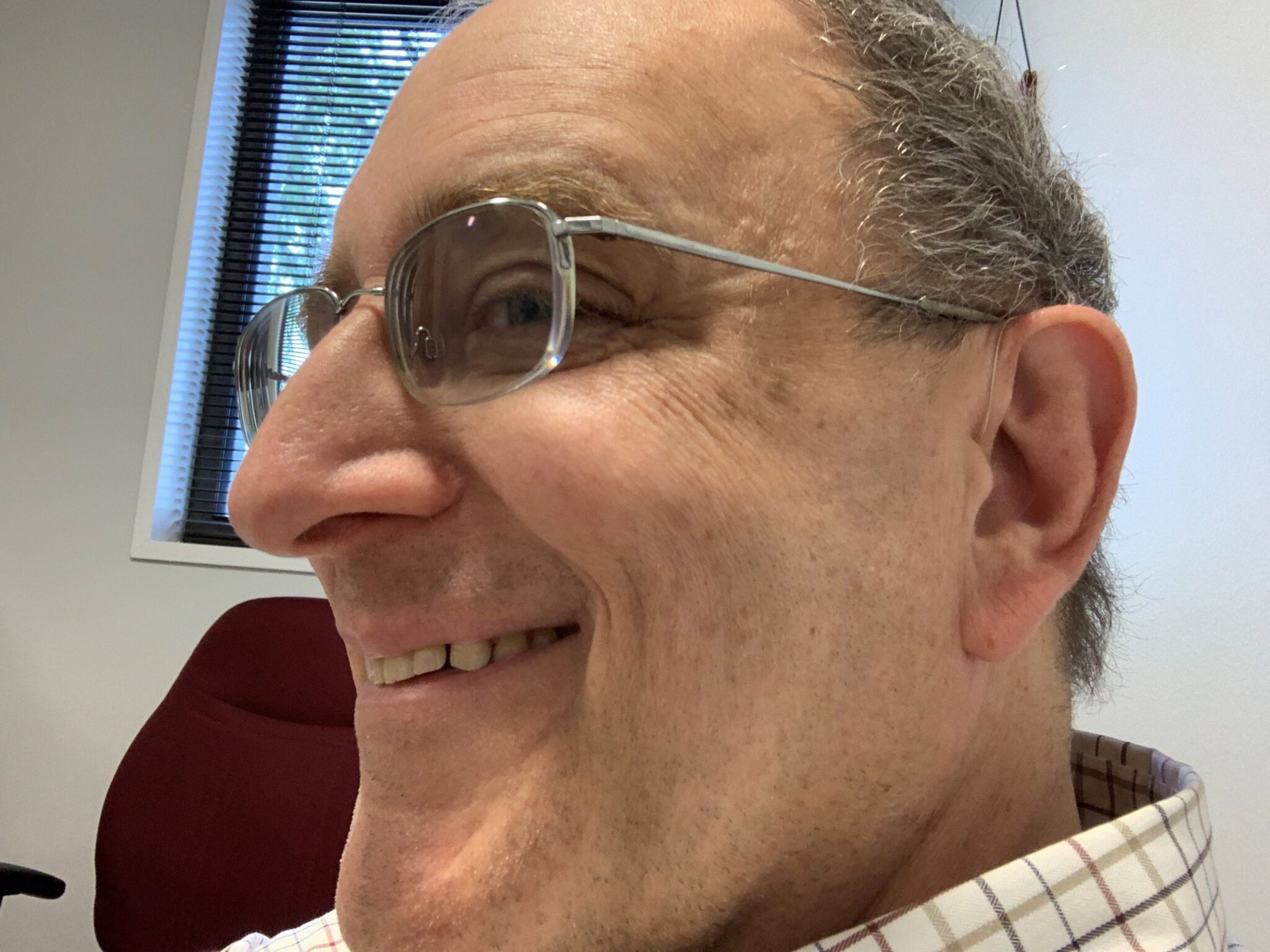
And voila, here is the hearing aid! You can hardly tell it’s there. I opted for a color that closely matches my skin; they have many shades, including an olive one (sort of like camouflage) that is sometimes selected by people with close ties to the military.
Chapter 6: What Should You Do?
I’ve read a lot lately about the ways in whichnotgetting a hearing aid can lead to deteriorating brain function. I believe it. Here’s a recent John Hopkins writeup on the topic. And here’s a terrific checklist from a recent Harvard study by Andrew Budson, MD:
- Keep your ears clean.
- If you can’t hear and you don’t have hearing aids, get them. Hearing aids now available over the counter can help many people with mild to moderate hearing loss.
- If you have hearing aids, wear them.
- If your hearing aids aren’t working, get them fixed.
- Don’t be passive — ramp up your social life and other activities. (You know what I’ll say for this one: get yourself singing in a choir!)
As for me, I am very happy with my new hearing aid. It feels like I’m hearing about 15% more sound in general, especially at the upper frequencies. Interestingly, it also feels like I’m hearing those higher-pitched sounds better through the right ear – a sort of unexpected stereo effect.
It’s very reassuring to rustle my fingers near my left ear and to hear what I used to hear.
I’m sitting outside on my back deck as I finish writing this, enjoying—with a grateful heart—the wind in the trees and the sounds of birdsong in both ears.
I had operations on both my inner ears many years ago to replace my stapes bones. About the time I retired eight years ago, I decided to try an economical brand of hearing aids from an ad I saw in Smithsonian Mag. I have since upgraded to Starkey Brand. I use them constantly and can’t function without them.
Marve—thanks for your note. I don’t want to go back to not hearing things well either!
I’ve had my hearing aid for about a year. My recognition frequencies quality and tones is more complete.
The power to the bottom line
Is I get to hear the world without wondering what I missed
That’s a good way to put it, Bob. It’s good to have more confidence in what we’re hearing, for sure.
I was hesitant to join because I wear hearing aid , both ears.
I now feel much more at ease.
Thank you for sharing this!
Hi Jill — so glad you are feeling encouraged. Welcome!
It’s no fun to get old. Good luck. You did the right thing, it took a long time for my wife to finally give in.
Thanks for the encouragement, Manny. It certainly helped that so many people I know already have hearing aids and have been saying good things about them.
I have been wearing hearing aides in both years for about 7 years and they work well. I need them especially for birdwatching, and I did get my hearing aides from my audiologist for many of the reasons you stated.
Dottie: Sandy and I just got back from Costa Rica, where we did several birdwatching tours. I can totally appreciate how important good hearing is for birdwatching! One of our tour guides was remarkable in getting birds to come near us through a series of bird calls. Amazing. I didn’t yet have my hearing aid on the trip, though, and I can imagine how much more I would’ve heard if I’d had it by then.
Thank you for sharing your journey–lucky you to be living now and not in Beethoven’s time. Now you’ll be able to detect when sopranos (me) aren’t singing the correct notes!! LOL
I have excellent hearing (76), thankfully from my father, I think. My mother lost hearing in her left ear as a little girl when a boy threw a snowball with a rock in it and hit her left ear. Later in life she got a hearing aid for her right ear and she was happy. Your sharing your story will likely help others get a hearing aid–like you benefited from others’ experiences. Yay, you. Thanks.
Aww, thanks, Diane. Yes, that was my intent with the blogpost, to tell my story in a way that is encouraging to anyone who is on the fence or just curious about hearing aids. I am so struck by the recent research that tells us how the brain is hungry for auditory input, so we need to feed it with sound!
And yes, let’s rejoice in the hearing that we do have. I am grateful that we have devices that can improve our hearing… really an everyday miracle of sorts.