
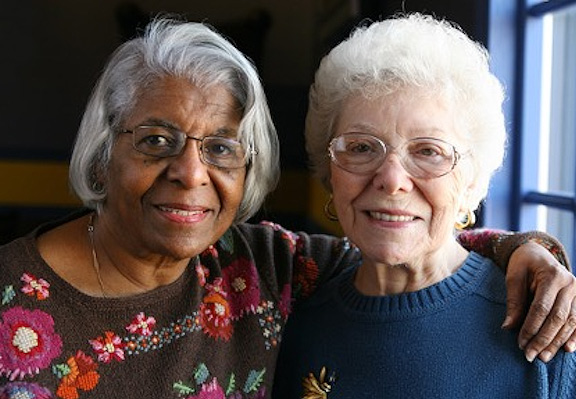
A number of singers in our choirs for older adults have had tragic losses and other difficult personal situations. I am deeply grateful that they sometimes bring me, Sandy, other conductors and staff, and fellow singers into their confidence. They share the hard things that are happening in their lives. My heart goes out to everyone who shares their difficulties. While I’m not going to share any particular details here, the thing that I want to write about today is the importance and value of sharing the hard stuff with one another.
Sometimes this is not easy.
I’m here to encourage us all to do it, anyway.
Over the summer, Sandy read a sermon she was working on to me; we routinely ask for each other’s feedback. Her sermon was about that “all dressed up for church” situation (you can substitute synagogue, or mosque, or family gathering, or reunion, or whatever), where we feel that we have to put on the outward emotional equivalent of a Facebook post: showing everyone how much we have it all together, not letting anyone see us sweat, bearing everything with a stiff upper lip, and so on.
Sandy essentially says in this sermon (in a friendly, deaconly way): that’s a bunch of crap. It doesn’t serve anyone when a gathering place—including choir rehearsal—is a place of falseness, where we feel that we can only bring our strong selves to the group. When we walk around with that unrealistic expectation, it misrepresents, and even undermines, the sense of what a community can be. That unnecessary burden of “I have to always look like I’m okay” doesn’t let anyone into whatever we might be struggling with. This in turn increases the sense of feeling lonely and disconnected. Who wants that?
So maybe it’s the expectation, this internalized pressure to always be perky, that’s part of the problem and the burden. Could we bring a different, softer, more vulnerable version of ourselves to the group… or maybe just to one person in the group… and see what that feels like?
 I want to share the quality of an interaction that happened. A singer sent me an e-mail about having some heartbreaking losses and didn’t feel ready to come back to choir. That was fine, I told the singer. This happened a few weeks in a row. Finally the singer wrote expressing uncertainty about when it would feel okay enough to come back to choir… and to me, this was evidence that the person was feeling pretty wobbly. Something inside me said, “You can’t let this go, Jon… it’s time to dig in, persist, and shower this person with love.” It felt important to say, as I did in my next reply to the singer (and Sandy did, too), that choir is exactly the place to come when you are not feeling 100 percent, emotionally. I wrote that we would welcome the singer back with open arms, a hug, and a sympathetic ear—if the singer would show up. This, to my delight and relief, is what actually happened.
I can tell you that having this singer come back lifted my heart like nothing else did that whole week. Seeing that singer return to rehearsal affirmed that what I said was true—choir is a place where you can bring your whole self—your vulnerable and wobbly, and even broken self—and we will welcome you and help you feel like you have a place here. This whole situation made me feel like I was the kind of person I most wished I could be. (Yes, says the choral conductor, it was even better than a perfectly tuned chord or a completely synchronized entrance or cutoff.) I believe it was so satisfying because all of us extended ourselves: Sandy and I offered support, the singer actually came back, and others in the group wrapped around this singer with love and hugs and kindness. And this has happened with more than one singer.
This past summer, I went to help out with music packets and registration at the first rehearsal for our dementia-friendly Sounds Good Choir in Northbrook. As part of his conducting, Paul said repeatedly that first day, almost like a preacher: “If you’re new here, and you’re not sure if this is your thing, or if you’re wondering if you’re ever going to master the material, or if you’re not sure how to follow along in the sheet music, or anything like that, just keep showing up. Come every week, and I promise you it will get easier. You will enjoy it more and more, the more you do it.” He was talking primarily about the musical aspect of being in choir, including coming to Friday Zoom rehearsals and working with practice tracks, but it applies equally to what’s going on in our hearts—and I know Paul well enough to know that he also means it about our emotional lives. Paul models the kind of vulnerability that I’m talking about, and it’s one of his most inspirational qualities.
 I will never forget one of the first times in my life that I almost gave up. I was fifteen. I had been used to being at the top of my class in high school, especially in math, and I went with my best friend to a nationally competitive, eight-week summer math camp where I was not the best. It was the hardest thing I’d ever done, and I got behind on my work, and I told my mom after two weeks that I wanted to quit. She told me to tell my counselor (sort of like an academic RA, a tutor in the dorm) that I was struggling. I did that, and guess what? He told me that just about everyone else was struggling too. (But nobody was ‘fessing up to each other. We were each individually coming to him, and just to him.) He gave everyone a fresh start the next day and said we could forget about the work we had missed to that point. I knuckled down and worked harder for the next six weeks than I had ever worked in my life. Even though I knew that I was never going to be as good as the very top people in that summer camp, I did better than I ever imagined I could. Now, 45 years later, I still recall with a thrill that twofold experience that unexpectedly created some resilience for me: first, the experience of being heard when I was in a hard place, and second, of my following that up by giving it my all. What mattered was not only that I didn’t quit, but that I told someone (really two people—my mom and my counselor) that I was struggling. Making myself vulnerable made all the difference in the long run. And I kept showing up after that, even when it was hard.
So I want to encourage you, and you, and you, and every one of you who think this doesn’t apply to you: choir is your place, too, even on bad days. This is your singing family, and it is exactly the kind of family where you can let people in if you’re struggling. Just because we’re working toward a great performance doesn’t mean that we have to check our humanity at the door of rehearsal.
If for some reason you aren’t feeling welcomed by the environment that we create here, please let us know, because we always can do better. But please bring your whole self to choir, tough times and all, crushing disappointments and tragic losses and health crises and all. Bring it all here. Lean on someone you know, and even try leaning on someone you don’t know that well… you’ll likely be surprised at the kindness you receive when you let someone in. Of course, if you need professional help with your mental or physical health, please get that too. But the saving grace of a choir is that every one of us is valued and needed, and not just for our vocal gifts, but for our hearts. You never know: the kind word or kind ear that you lend to the person next to you could be exactly what that person needs to make it through a particularly tough day. And something that lifts your heart might lift someone else’s, too.
I want to close with a quote from the late Adrienne Rich, a poet whose work I love, from her book, Sources: “There must be those among whom we can sit down and weep, and still be counted as warriors.” My beloved minister from my years on staff in the Unitarian church, the late Rev. Dr. F. Jay
Deacon, would often close a worship service at Unity Temple with that quote, as a benediction. The poet Adrienne Rich was on the skinny branches of feminist/lesbian/political thought for much of her career, and she was writing particularly for and about people who felt that there was no such place for them in the world. Sometimes we older adults also feel like we are on the margins of the world and there is no such place for us. However, Rich goes on: “… perhaps there was none then, and perhaps there is none now; but we will have to make it.”
When we’re having a hard day, the warrior quality of which Adrienne Rich speaks—not one of aggression or violence, but rather a quality of bravery and virtue—is the quality of heeding that inner call to lean in. Try to heed it, if you can, and keep at it. Try to speak up, to say the thing that’s weighing you down, to listen to the hard thing that another is living with, to keep the heart open even when the bells in your head say to shut down—for that is when we can be counted as warriors, even as we sit down together and weep.
That’s the world I want to live in. Come to choir even when you don’t feel like it, and we will build that world together.
Well, Jonathan, that is about the best “sermon” (sorry Sandy) I’ve read in a very long time!! Thank you for your perspective and compassion. And you live out your values–I saw you comforting a very close friend of mine one day after rehearsal and saw the care and concern you had for her. Thank you. I am grateful for Sounds Good Choir and the beautiful music we produce and also the warmth of friendship and support we demonstrate for each other. You and Sandy model this caring for us. Grateful, I am.
This is a lovely call of encouragement to all who are struggling. Thank you Jon.
Thanks, Jonathan, for all your kind and caring words. As you know, I have in the last several months shared my experience of surgery with you and Paul, and not only did I receive your caring response to me gratefully, but you set an example for me! Today, after my appointment for a tooth filling, my dentist sat down and shared his issue of understaffing since Covid. He has always striven to create a warm environment for his employees and patients, but nowadays the assistants and hygienists may cut their own hours, not work on Saturdays or simply quit. I listened for about 20 minutes, which reflects the 20 or so years that he’s been my dentist. I have seen them all, over these years, as “extended family.”
So, I greatly appreciate you and SGC. See you in rehearsal!
This blog touched me. Thank you, Jonathan and Sandy, for this wonderful choir family.
I’m so glad I found this choir. Not only to sing beautiful music but to be surrounded by wonderful people who care about you.
That Adrienne Rich quotation–such a perfect expression of what we all yearn for. Thanks for this blog post. Something important to think about. I hope to join up again with you all right after the holidays. I’ve been imagining I am too busy to sing. Ah foolish me!
I love belonging to this choir. I love it for the singing but also for the concern and love you have shown the members from day one. It is evident and your blog confirms this. Thank you
I shared with Jonathan that several people told me how his blog touched them. So timely for many of us. I shared that I learned it is okay to say, ” No, I am not okay right now.” No judgment, just a nod and a hug received.
“Just show up.” For a brief respite, be in a safe place, sing, listen, be present. Jonathan and Sandy have gifted us with a wonderful opportunity.
As chorus liason for Hinsdale, I strive to emulate Jonathan, to provide support and a listening ear. Sounds Good Choir is a safe anchor for many of us.
I shared with Jonathan that several people told me how his blog touched them. So timely for many of us. I shared that I learned it is okay to say, ” No, I am not okay right now.” No judgment, just a nod and a hug received.
“Just show up.” For a brief respite, be in a safe place, sing, listen, be present. Jonathan and Sandy have gifted us with a wonderful opportunity.
As chorus liason for Hinsdale, I strive to emulate Jonathan, to provide support and a listening ear. Sounds Good Choir is a safe anchor for many of us.