
Sometimes, when you get together with an old friend, it’s pure joy. You find yourself easing right into conversation, as if you never missed a step, even if it’s been 40 years since you sat down together. This happened to me in 2021, when I went to the Big Apple to hear the Basie Band play at Birdland for two nights; my friend Bill Flowers has been the band’s No. 1 groupie for decades, and I got to hang with him in the front row for four shows straight, mouth agape at the mastery of the players and at the intricacies of Mr. Basie’s musical brain.
The next morning I took the subway to Brooklyn, where I spent the whole day with my childhood friend, Steve Rosenbush. I hadn’t had an extended conversation with Steve since the day we graduated from high school. But you’d never know. Having been thick as thieves in high school, we got right into it and shared one of the most truly delightful days of my life—a combination of reminiscing, going over old material from earlier in our lives and catching up on what was happening with family, work, mutual friends and so on. The day flew by, and I was sorry to have to head to the airport for my flight home.
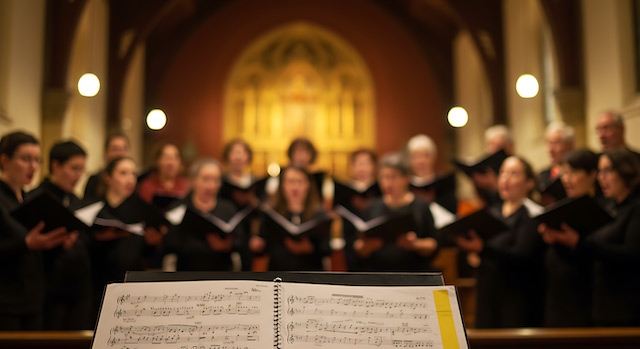
There are similar joys to be had when revisiting songs from earlier in our lives. I’m saying this in part because of the focus of our Spring 2026 session is a celebration of the 10 years that Sounds Good Choir has been in existence, starting way back in early 2016. What’s a reunion like with songs you have learned and sung in years past?
Why singers and musicians revisit songs they’ve already learned
At Sounds Good Choir, we have a stellar track record of coming up with programs of brand-new music for our singers and audiences to enjoy, and that’s clearly part of the fun of singing in our choirs. So I can imagine it might seem a bit odd, perhaps even a bit disappointing, to be revisiting songs from previous years.
While that’s a natural feeling, I’d like to encourage you to look at our spring repertoire from several different angles. The first of these is the joy of doing something better than you did it before. Have you ever had the experience of, for example, mastering a yoga posture that you previously found difficult (or even not doable), or making a beloved recipe once again and having it turn out even better than before, partly because of its familiarity?
There are at least two aspects to learning musical material. One is the learning part, where you are actually learning the notes and rhythms and lyrics for the first time. This is a lot of what we typically do in the first 8 weeks of a Sounds Good Choir or Good Memories Choir spring or fall session (and the first 4-5 weeks of Summer Rocks, especially the harmony parts). The second is what I’m mostly talking about here: the mastery that comes from repeated or prolonged experience. This is where, if you’re a singer who has sung some or all of the spring 2026 material with us, I want to be your cheerleader.
Rah! Rah! Sis-boom-bah!
Sing better vowels than you ever did be-fah! 😊
Let me share a recent personal experience with you that relates to our discussion. In December I was invited, along with Amy Wurtz, to be the sing-along leader and featured soloist at a “musicale” for residents of The Clare that was hosted by our long-time singers and generous donors, Jerry Talen and Joanne Celewycz. They hosted a similar event in 2022, when we were barely emerging from the pandemic. That night in 2022 I sang two solos (a recitative and aria from the Messiah), and the three other vocalists also contributed their solo talents. This December, with Amy at the piano, I sang those same two Messiah solos, plus two more, for a total of 4 solos (2 recitatives and 2 arias).
It was a great night for me vocally—I have been working with my teacher, Karen Brunssen, in lessons roughly once a month for much of this year and working hard between lessons to improve my technique. It is paying off. Several people said they had never heard me sing better. That was nice, but the real joy for me is in the continued reacquaintance with this same musical material, which I first approached when I was 16 or 17, still getting to know the bass voice with which I was gifted around my 13th birthday. I sound quite different at age 63 than I did at age 17 or even 60. It’s a joy to dig back into material that feels like a well-worn old shoe or glove, and to work it back into my voice. I’m not the same person, emotionally or physically, that I was the last few times I sang those solos, and it’s a process of continual discovery and re-discovery. That is one of the great joys of working with excellent musical material that stands the test of time.
* * * * * * *
Speaking of material that stands the test of time, our Spring 2026 session includes “At the River,” the traditional Christian hymn written in the 1860s by the American poet and composer Robert Lowry. Aaron Copland arranged it for solo voice and piano as part of his second set of Old American Songs. The first set, which premiered in 1950 at the Aldeburgh Festival, was a project for the English tenor Peter Pears and composer/pianist Benjamin Britten (the two world-class musicians were not only a brilliant collaborative team, but also life partners long before it was safe to say so). William Warfield, the great American baritone, gave Set I its U.S. debut a year later, with Copland himself at the piano. The set proved so popular that Copland wrote Set II in 1953, with the Warfield-Copland duo premiering that set in 1954, featuring “At the River.” Our version for four-part choir was created by Raymond Wilding-White, former composition faculty member at DePaul University. Beautifully crafted, Wilding-White’s settings have become classics of the choral literature.
If you were one of the singers who performed “At the River” with Sounds Good Choir in 2018, I might suggest a few things to help you approach the material again. One question is the same one that I ask myself when working with a song I’ve sung before: what was difficult about it to sing the first time (or the most recent time)? When I look at the score, I see a few things that could give some difficulty. There are dramatic shifts in dynamics (volume) during the song. Also, the soprano and tenor parts are on the higher side, tending to hang pretty close to a high F—not the easiest pitch to sustain. In addition, some of the harmonies are not 100 percent obvious, especially the alto and bass lines; they sometimes differ from each other by a 7th or a 9th or some other weird and dissonant interval, making it hard to tune properly—even though this is how the piece is written. Another challenge comes from the number of places in which the phrase ends with a crescendo, which can be a challenge in terms of keeping the vowel shape stable.
All of our conductors will be helping you to navigate the bumps in the road with this piece—that’s our job! The good news is that there are great rewards on the other side of all that work. With big thanks to Linda Crabtree Powell for the inspiration and model to hold recap sessions—a lovely way to end a choir semester, which we’re now do in all Sounds Good Choir locations. Many of you are sharing your joy at the accomplishment of having successfully learned and performed some difficult material in the Fall 2025 session that just ended, namely Rutter’s Shepherd’s Pipe Carol and the intricate sections of Jingle Bells Hallelujah. You did it!
You can do it again with our new pieces this spring. In the case of “At the River,” there is a power in the restraint that Copland puts in this setting, where he never quite puts the gas pedal down until the very end, and then there’s a relief at being able to go full tilt, when the lyric ends, “… that flows by the throne of God.” You have a sense that you’re truly arrived right there, that our “pilgrimage” (perhaps also of learning the danged song?!?) has happily come to a close.
If you’re new to this piece, I hope you end up loving it. If you’re a repeat visitor, I hope you’ll dig in and make it your own in a new way. In either case, it will be a joy to have you singing in our choirs in the spring, and I wish you well!
You old fox!
If you had told me that you were going to “revisit” past pieces, I would have saved the music, annotated in the colorful secretive hieroglyphics that a non-reader like myself uses to navigate music!
But, alas, I recycled it in November.
I’ll have to buy a whole new set of colorful highliters!
But at least I’m forewarned to keep THIS music for 2036 when I will be (hopefully) a nonagenarian and you will still be a young’un!