
What Conductors Actually Do With Their Hands
In an earlier blogpost, I wrote about the role of the conductor in the life of a choir—the ways in which we are leaders, the practical things that we worry about like repertoire and time management, the emotional responsibility that we carry for the music, the need for us to provide inspiration, and so on. Today I’d like to focus more on the things that are most visible: beat patterns—what we do with our hands.
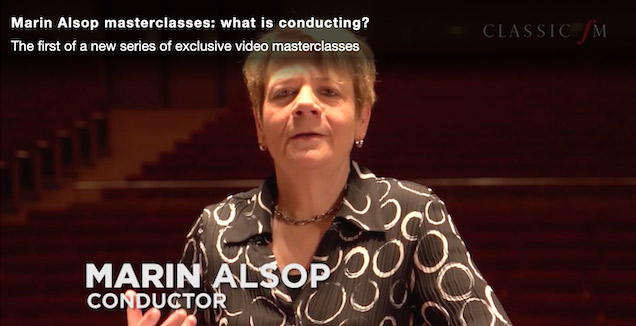
Marin Alsop leading a masterclass on conducting for Classicfm
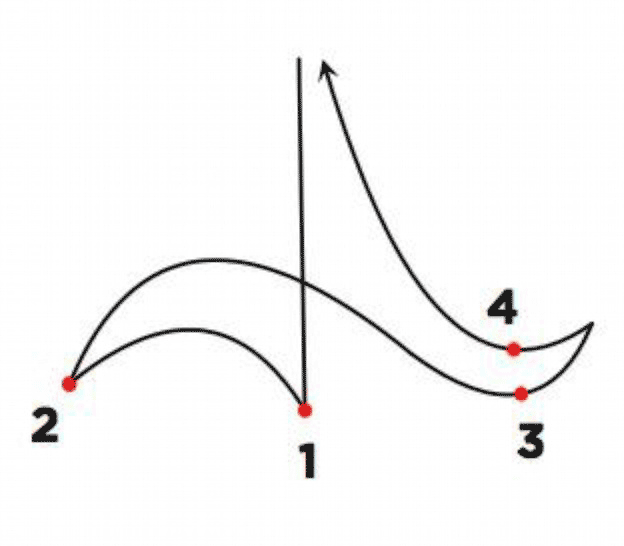
Diagram pattern for beating a 4/4
If you scroll down through the videos, you’ll see the particular challenge of beating in only 1 beat in your pattern: there are good reasons for doing this, but it demands some finesse from the conductor.
Two days in my conducting life have had the most impact on my technique. The first was a day in 1994 when Chicago a cappella was doing a joint concert with the chamber choir then known as His Majestie’s Clerkes, now known as Bella Voce.
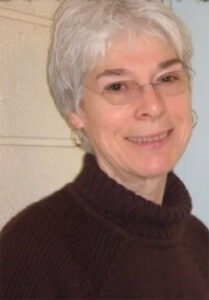
Anne Heider, Artistic Director Emerita, Bella Voce
The second remarkable day in my conducting life came in the fall of 1999. Let me tell you a little story to set this up. Chicago a cappella at the time was getting a bit of a reputation for itself, which was gratifying. To support my young family while building that group up, I had worked about five years before that in the music publishing industry, where I bundled together a bunch of different services for book publishers (things like copyediting, proofreading, music typesetting, illustration, and sometimes even printing). While in graduate school in Chapel Hill, at the University of North Carolina, I had gotten to know the president of Hinshaw Music, a well-known sheet music publisher from that part of North Carolina. Roberta and I had been singing together in a local community choir, and we got along well.
I pitched Roberta not only on the idea of having Chicago a cappella record the demos for all of her new releases for the coming year, but also on the idea of “one-stop shopping,” where she would send us the sheet music and I would send her a final compact disc, in a nicely printed cardboard sleeve, with all of the pieces listed on the back. The result was that they could send the CD out with the packets that they would send out a few times a year to choral conductors all around the country. If you think about all of the recordings that Paul Langford produces for Sounds Good Choir, it’s not that different from what CAC did for Hinshaw, except that Paul’s recordings are all digital MP4s and are posted on YouTube, and he does his magic with singers in different locations. I had eight singers and a pianist in the same room, a little studio in Roscoe Village called Airwave, run by engineer John McCortney.
The big challenge in this recording project—which has shaped me as a conductor ever since—was that one of the first assignments from Hinshaw was the Requiem by David Huff, a gorgeous piece for choir with soloists, organ, and string quintet. It had been five years since Anne Heider told me I needed a better point to my beat, and I’d been practicing that every chance I could. But string players are known for being rather demanding (and, unfortunately, the reputation that choral conductors have in the orchestra world was, for a long time, that of second-class musical citizens), and I’d hired some of the best freelancers in the city as our studio quintet. Simply put, I was intimidated and terrified. I didn’t want to be a schmuck and be unprepared. What to do?
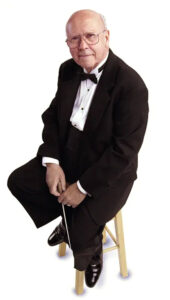
Paul Vermel
Paul was very kind and patient with me. He explained to me that “conducting is the art of using space to demonstrate concepts of time.” That totally made sense to my nerd brain.
He also told me that the most important thing you can do as a conductor is, yes, to have a clear beat, but the second most important thing you can do—which really hit home with me that day—is to change direction on the half-beat. The reason for this, he explained, is that musicians are constantly doing calculus in their heads while they watch you, to see where your hand (or baton) is going. If you can give them clear visual information at the level of the half-beat, they’ll be able to do the internal calculation, and you’ll have a much better chance of having everyone arrive together on the next full beat. That also totally made sense to me. So I practiced that a bit while I was with Paul at his house.
Once I kind of had that learned somewhat decently, at least conceptually and somewhat with my gesture, he got excited and said, “And this is the secret to speeding up, because when you accelerate the half-beat, everyone will instinctively follow you and move more quickly, and they’ll end up on the next full beat at the faster new tempo. Try it.” So I did, and it was amazingly cool and clear to me that it could work. We did this for a while, both speeding up and slowing down.
One other little detail that Paul mentioned is that some conductors (perhaps in our local area?) make a little loopy thing with their beat pattern between beats 3 and 4, and he dismissed it. Calling it “the Chicago loop,” he discouraged me from conducting that way, saying that it confuses people.
The hour came to a close, and Paul Vermel said to me, “Okay, that’s about it. Take what we’ve done in this hour and go and practice it for the rest of your life.” And, with ongoing gratitude to Maestro Vermel, I have done just that.
In the very short term, I went into the studio the next week to record the Huff Requiem and really did a very serviceable job, not as terrified of the string players as I would have been if I hadn’t had that lesson. That was more than 25 years ago, and I’ve logged thousands of hours since then, practicing what I learned that day.
Nothing like great teachers to change the trajectory of your conducting!
Please provide comments and questions… I’d love to hear from you.
0 Comments