
How can an almost unbelievably beautiful tune also be almost unbelievably complicated?
I was talking the other day with our recently arrived Sounds Good Artistic Director, Chris Cherry. We were sitting down together on the first occasion that we had carved out in our schedules to actually roll up our sleeves and look at sheet music together. Here’s a little peek under the hood of our choirs for older adults:
In our roles as artistic directors, part of what we do is to look carefully at the printed scores and specify where—on top of whatever the published score might indicate—we believe there should be additional breaths (or phrases where we mark not to breathe), and so on. Once we’ve done this, we give the scores to Ellen Buckingham from our office, who scans the scores and put them on a sharable drive. Then we share them with Paul Langford, who masterminds the creation of our practice tracks for each session.
One of the pieces that we’re doing this fall is an arrangement of the “Huron Carol,” set for SATB choir by Mark Burrows. Chris smiled as we were walking through this one and said something like, “I’ve never seen a version of the ‘Huron Carol’ that wasn’t beautiful.”
I feel the same way.
The text of the “Huron Carol” comes from a non-Indigenous Canadian poet named Jesse Middleton. In 1927, Middleton created an English translation and published it in a little book called The First Canadian Christmas Carol. Canadians of European descent loved it, and the song with these new English words have become iconic and well-beloved across Canada and the English-speaking world in general. When I was artistic director of Chicago a cappella, we sang two different a cappella versions of it, one arranged by folk musician Steve Schuch and one by Eleanor Daley (click on the links to hear the recordings on YouTube). Can you tell why Chris and I love this tune?
I don’t want to take anything away from the beauty of this tune nor of Mark Burrows’s setting for choir, and I’m happy that our Sounds Good Choirs will be performing it in December. At the same time, here is a spoiler alert: there is both tremendous beauty and deep tragedy in the story of this song. The beauty comes largely from the melody itself, which seems to be based on a 16th-century French tune that goes by various names. One name of the tune is “Une jeune Pucelle” (A Young Maid), with a French text about the Virgin Mary and her role as the mother of Jesus. Here’s a recording of the tune set to four voice parts, sung by the Ensemble Clément Janequin, one of the leading early-music groups in Europe. You can hear the tune in the opening cello part of this rendition by Loreena McKennitt:
It’s just a gorgeous melody, and you can see why people have been drawn to it for so long—and why choirs and choral arrangers keep performing and arranging the tune in various ways. The version we’re singing is, as I said, by Mark Burrows, an experienced American choral arranger.
There is also a sweetness to the lyric that draws us in, and despite the issues with its creation, it’s easy to see why people love the combination of music and text. Let’s go on to the issues… it’s fascinating stuff, if not the easiest to read about.
* * * * * * *
The name “Huron Carol” is itself a bit thorny. The people from the area of the St. Lawrence River in what is now Ontario and upstate New York call themselves Wendat (sometimes spelled Wyandotte). After various relocations and defeats over many centuries, they are now part of the present-day Huron-Wendat Nation. Here is their territory as of about the year 1600:
The Wendat Confederacy was defeated by their bitter enemies, the Haudenosaunee Confederacy and dispersed from Quebec to Wisconsin. They also were allied with the French side during the French and Indian War (1754-1763). The United States eventually forced tribal members to sell their lands, and some migrated to Kansas and Oklahoma.
So how do we get a Christmas carol from the “Huron” people?
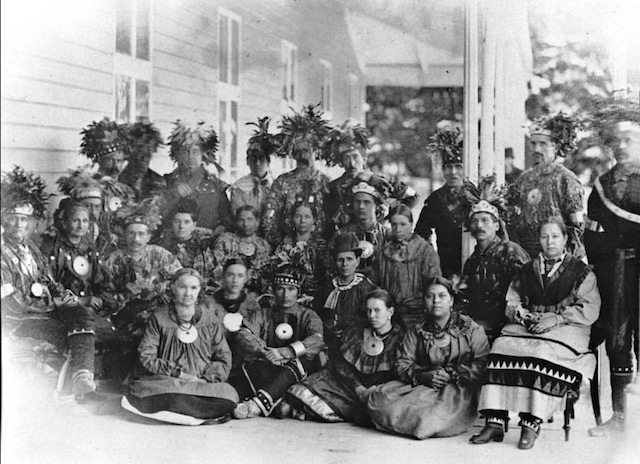
Wendat group from Wendake (Lorette) at Spencer Wood, Quebec City, 1880 (Photo courtesy: Jules-Ernest Livernois, February 11, 1880, Silver salts on paper.)
A lovely and seemingly innocent piece of music can perpetuate damaging stereotypes and history, if we’re not sensitive to the nuances of the cultures and people around us. It’s my observation that Canadians are ahead of Americans in owning their past. By this I mean that your average Canadian citizen seems to be more sensitive than your average American to the long-term consequences of European colonization of the Western Hemisphere.
Over my travels in Canada during the past ten years, I’m impressed at the ways in which Canadians have started to acknowledge the many ways in which damage has been done. The destruction of what in Canada are now known as First Nations peoples is something that Canadians talk about more regularly than we in the States talk about either our treatment of Native Americans or our country’s history of enslaving Africans. Canadians are working hard to restore justice, including even returning land to peoples in important and substantive, not merely symbolic, ways. One of the most impressive involves the Haida Gwaii lands in British Columbia, of which 98% of the land (north of Vancouver Island) was returned to the Haida people after a negotiated process. Another is the more open conversation—even though it’s clearly painful—about the residential schools established across Canada in an effort to obliterate First Nations identity. Another is the extraordinary effort to create the Nunavut territory in far northern Canada, which was done in a culturally sensitive way that included bringing Indigenous voices so closely to the table that the non-Indigenous participants ended up being convinced that the return of territory had to include water as well as land, because of the ways that First Nations people lived, worked, and traveled. (For more on that last one, read Radical Cartography by cartographer and historian William Rankin, which I read on vacation in Canada in May. Incredible, though admittedly nerdy, stuff.)
* * * * * * *
In the 17th century, a Jesuit missionary was sent to the Wendat people, a priest named Jean de Brébeuf. After training in Rouen, he was assigned to “New France” (now Québec) where he lived among the Wendat, learning their language—which is in the Iroquoian family—and teaching, with the primary aim of converting the Wendat to Catholicism. He was so adept at the Wendat language that he taught it to other missionaries and colonists. It took him almost ten years to convert any of the Wendat, which he claimed was a result of how long it took him to learn their language well. While the Wendat were warming to his message, however, they were also dying of smallpox; by 1640 nearly half of them were wiped out. A community of Wendat migrated eastward in the next generation, and in 1697 many of them settled permanently in Quebec City in a neighborhood still called Wendake, in which about 2,000 Wendat still live.
Around the year 1642, as part of his work, Father Brébeuf wrote a poem in the Wendat language about the birth of Jesus, and set it to the tune I mentioned above, “Une Jeune Pucelle.” This tune, and Brébeuf’s lyric, became part of Wendat culture, such that in 1668 a girl sang it on her deathbed on Christmas Eve. The letter that tells this story is the first reference that we have to the song now known as “The Huron Carol.” The tune in Wendat is called “Jesous Ahatonnia.”
* * * * * * *
Another major piece of the puzzle about this tune involves the English text. There are several problems with it. First is the title itself. The poet (Middleton) collapsed the Wendat and Huron peoples, which, although they are at present part of a combined nation, were not so at the time. In addition, the term “Huron” is a French term meaning “like a boar’s head,” referring to the way Wendat men wore their hair standing in bristles. The word “Wendat” means “dwellers on a peninsula” or “people of the island.” “Huron” is not completely neutral, therefore, nor is it complimentary.
In addition, Mr. Middleton—who evidently was more concerned with fitting his lyric to the French tune than to cultural fidelity with the Wendat—confuses Wendat with Algonquian in that the reference to God as “Mighty Gitchi Manitou” were not concepts in Wendat culture. As Will Pearson notes:
“The translation is a romantic version done by a non-Indigenous person and leaves out some of the emphasis of the original,” says Mark MacDonald, the national Indigenous bishop of the Anglican Church of Canada. “My understanding is that Jesus in the original is placed more firmly in the cosmology and world view of Wendat people.”
There is a subtle turn in the Wendat lyrics that Brébeuf wrote, basically saying “You know, those older spirits really weren’t the right ones. Jesus is the one you want.” But, as I understand it (and I’m no expert in Wendat culture for sure), he kept cultural references that the people would have appreciated. Here is the English translation of the verse when the wise men come, provided by singer Bruce Cockburn, who recorded it in Wendat:
Dau yishyeh sta atyaun errdautau ‘ndi Yisus
avwa tateh dn-deh Tishyaun stanshi teya wennyau
aha yaunna torrehntehn yataun katsyaun skehnn
Iesus Ahattonnia, Ahattonnia, Iesus AhattonniaAs they entered and saw Jesus they praised his name
They oiled his scalp many times, anointing his head
with the oil of the sunflower
Jesus, he is born
Contrast that with Middleton’s version:
The earliest moon of wintertime is not so round and fair
As was the ring of glory on the helpless infant there
The chiefs from far before him knelt
With gifts of fox and beaver peltJesus your King is born
Jesus is born, in excelsis gloria.

Will Pearson summarizes the issues well in an article in the online magazine Broadview:
The Jesuits were successful in Christianizing the Wendat people, and for hundreds of years l’Église Notre-Dame-de-Lorette, the small Catholic church in Wendake, would ring out with the sounds of the carol at Christmastime. Today the song is still sung in Wendat at the church, where it is afforded a special place in Christmas masses, usually as the communion or the opening hymn.
Outside of Wendake, the song has become even more popular. Often received as an example of Indigenous heritage, it has been recorded many times and is a Christmas concert staple. It inspired at least four illustrated picture books and was even honored with a national series of postage stamps in 1977.
But for some, the colonial context of the song’s origin complicates its meaning today. The carol represents not just the birth of Jesus in and for North America, but the delivery of the Gospel by European missionaries. As such, the song’s history is intertwined with the destructive presence of the church in Indigenous communities. In the 1950s, the Missionary Society of the Church of England in Canada recommended screening a National Film Board documentary about the carol in Canada’s residential schools, illustrating the song’s potential power to assimilate.
Nevertheless, many Indigenous Christians in North America have embraced the Huron Carol and sing it every Christmas season. The carol has come to occupy a significant place in the cultural history of Canada as a whole, but its messy lineage and complex legacy are often overlooked when, each December, it is performed yet again.
* * * * * * *
It’s easy, of course, to paint Middleton as a sort of cocksure straw man who was blind to the dangers of cultural appropriation. That’s not my intent either. And I’ve gone on at some length here because I feel that the issues here are important and sometimes ignored, even as they are fighting to be acknowledged and struggling to reach the light of day where we can even talk about them.
I remember that, during that seemingly far-off period known as the pandemic, some of our online coffee chats began to touch on topics the ones I’ve touched on today. I hope that, once some of the wars (and hopefully the wildfires) start to calm down, or even despite them, we can slow down a bit once again and, for those are so inclined, open our hearts and minds to become ever more aware of the ways in which we treat one another, including how we use language to keep people in and, sometimes unfortunately, to keep people out. We are in a tragic cultural time of great “out-keeping,” and it takes more work to welcome others into our circle than to resort to reflexive “othering”… and yet my own experience is that welcoming people in, saying “you’re one of us, and there’s room for all of us here,” is the greater work. It’s the sort of work that Canadians have been doing in earnest; I am grateful for their courageous examples.
Gee, you thought you were just going to read a little history of a lovely tune! You might have gotten more than you bargained for. If you’ve read all the way to the end here, you have my thanks… drop me a note in the comments and let’s keep the conversation going.
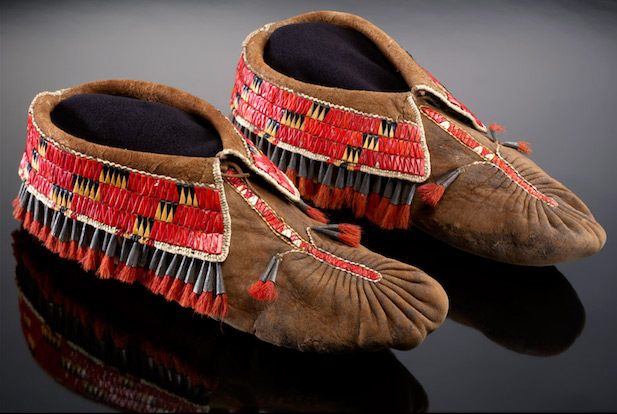
These cuffed, soft-soled Wendat deerskin moccasins, circa 1800, Canada, are made from hide decorated with porcupine quill, metal cones, horse hair and dye by a very skilled artist. Red, yellow, and black quills were flattened and folded back and forth across a lane and stitched around the each cuff, then edged with white quills. (Photo courtesy: Infinity of Nations: Art and History in the Collections of the National Museum of the American Indian | The National Museum of the American Indian | George Gustav Heye Center | New York, NY.)
What a fine piece of song scholarship, Jonathan! The complicated history and provenance of the song we know as “The Huron Carol” is an example of how a song can be adapted and owned by people upon which it was imposed. Knowing this history adds precious meaning to the experience of singing it.
Dear Jonathan, It is clear that you know more about the Huron Carol than the rest of us. That you placed the hard part so far into your essay means that many people will not get that far, and that those who do will see the hard part wrapped round by the beauty of the melody. It’s also clear that members of our audiences will not have read the essay and may miss the hard part, may be soothed by the beautiful melody into thinking the complications—the hard parts—aren’t all that important.
My response to the carol was not researched or rational. It was instinctive and from the heart and gut. European colonizers destroyed Indigenous cultures in so many ways that we now, some of us anyway, call October 12 not Columbus Day but Indigenous Peoples Day instead. When I saw the Huron/Wendat words used to bolster the Christian birth of Christ, I knew I couldn’t join my voice to a musical message that might lead some who hear it think that the colonizers weren’t so bad after all.
When I raised this discomfort in the Hyde Park group (I think I was the first) my intent was not to foment trouble or change Sounds Good repertoire but to state my personal decision. Looks like my speaking up has been part of a wide “conversation” that may well be, in John Lewis’s words, good trouble. I will, with respect, not be singing the Huron Carol.
Thank you, Jonathan, for unwinding a bit a complex history of a beautiful sounding song. For some time, I have been drawn to exploring places in Quebec. Quebec City is one place to visit beyond and that is due to my love of beluga whales. I would appreciate knowing places there that tell true stories of the experiences of First Nations’ peoples, and hopefully not romanticized tales that soothe historically traced culpabilities. Barbara Randolph, Ed.D., Hyde Park Sounds Good Choir dreamweaverb@yahoo.com
Thank you for this summary (long summary?) of a co
mplex issue. It is such a lovely tune. I am glad we are singing it, but also glad to know more of the history.
Thank you for this history of the Huron Carol. I love the melody and the reference to “Gitchy Manitou”’ and the indigenous people in Canada. I come from New Engalnd where many Canadians settled during the industrial revolution.In our Catholic bilingual(French and English) schools we spoke of the Iroquois and the Huron Indians. Admittedly we referred to them because the Indians martyred the priests and missionaries who occupied the land at the time. My grand parrents and great grand parents were born in Canada. With the passage of time and in the 20th centurythe area became more peaceful. We would visit relatives in Canada every year, with my grandparents. And I had my own Indian doll that I cherished.
Jonathan;
Thank you so much for this exploration of the history of the Huron Carol. I am so grateful, having sung it in church for many years, never understanding it’s complex history. I’m very grateful for this, and will show it to my pastor and church music director, who would really care to know this.
I wrote a comment earlier today which must have gotten lost. Let me try again.
Dear Jonathan,
Clearly you have done your homework. I hope SoundsGood singers will make it all the way past the beauty of the melody to the hard part of the words. Even if they do, our audiences won’t. My concern is that they will be beguiled by the melody and conclude that whatever is wrong about the words can’t be that bad.
My reaction to the Carol was not researched or rational. It was spontaneous and from the wells in me that have learned over the years how many different ways we European colonizers have destroyed the lives and cultures of North American Indigenous People. I cannot with good conscience lift my voice to sing Huron words that bolster the Christian belief in the birth of Jesus Christ.
When I voiced my dismay, it was not to change anyone else’s mind or this season’s concert repertoire. The ensuing “conversation,” however, lets me think it has prompted(in John Lewis’s words) some good trouble. And that’s a good thing!
I read the Will Pearson article cited in your post and found the following two paragraphs to be of particular interest:
Earlier this year, a community choir in Calgary asked Tony Snow, a member of the Stoney Nakoda Nation and co-ordinator of community and pastoral care at McDougall United in Calgary, for his reflections. Snow emphasized the importance of not only interrogating the colonial intentions of the early missionaries, but also of honouring the creative ways Indigenous people responded to Christianity, and the spiritual generativity that resulted from the meeting of the two cultures. Snow believes Jesous Ahatonnia is an example of this kind of spiritual exchange. “The song is a marriage between Christian and Wendat belief systems,” he says, “and was used to bridge understandings and build better relationships.”
Snow acknowledges that some of the English translations used today can sound “altogether racist to modern listeners.” He says one solution to this is “to learn the original version, honour it and find an English version that holds true to the original intent.” Doing so may itself be an act of reconciliation, modeled on the song’s original author: “de Brébeuf took the time to immerse himself in [Wendat] culture, learn the language and honour his hosts with [the Huron Carol],” Snow says.“This mindfulness should be our model of understanding in reconciliation.”
I have to admit that I am among the modern listeners who find Jesse Middleton’s lyrics deeply offensive. My gut reaction upon reading them for the first time was, “I can’t believe they want us to sing this in public.”
I suppose one could argue that moving the nativity story from Bethlehem to the American forest is a simple exposure of what Christianity considers its universal message to a new audience of souls needing to be saved. Apparently that was what the missionaries who took on the project of converting the Indians to Catholicism thought they were doing. The trouble with that argument is that Christianity arose in a cultural and historical context which included Judaism, the Roman Empire, and centuries of history, religious practices, and prophecies. The shepherds who knelt before the creche belonged to that world and behaved accordingly, but to the Indigenous Americans of the seventeenth century it was utterly alien. To ignore that difference is to deny any cultural reality to the Indians and picture them as empty vessels waiting to be filled with the white man’s religion and culture. It allows them to be dropped into, as Pearson describes the scene in the Huron Carol, “an Indigenous Nativity with “hunter braves” replacing the shepherds in the field, a “lodge of broken bark” standing in for the manger and “gifts of fur and beaver pelt” being delivered by “Chiefs from far.” (If that sounds like a prompt for ChatGPT, try it and see what comes up.) It also permitted the centuries of ill treatment the Indians have suffered under White rule.
With Respect to Jon Miller
Just because this carol has been sung for many years doesn’t mean that it should continue to be with the same words. The tune was originally for another song. Many Stephan Foster and Copland Old American Songs have had words offensive to modern sensibilities changed.
Dear Jonathan, I find that some of your research regarding the “Huron Carol” is similar to mine, but our analyses and outcomes are different. Yes, it is a beautiful tune, but it is not the music of Wendat creation. Indigenous people had their own music and traditions well before the white, colonizing missionaries attempted to assimilate native peoples into the broader white, Christian culture. French Catholic missionary de Biebeuf immersed himself in the Wendat community, learned and spoke their language, not out of respect for them, but as a way to exploit his familiarity to steer them towards Christian conversion. Missionary intent focused on teaching the indigenous peoples that Christianity was superior to their traditional practices. I find this disturbing and contrary to my own personal beliefs and truth. Therefore, I will not be able to sing this carol with the Hyde Park choir.
I would appreciate guidance about what to do while others are singing–stand, sit, remove myself, etc. Also, it was my understanding that there would be a zoom Town Hall for Sounds Good choirs to share their opinions and feelings, as well as ask questions. Will this still occur? I respect the choices of other members and am grateful for the opportunity to express myself.
Thank you for this post. After reading it, I feel a bit conflicted about singing the song but I’d like to hear how others in the choir feel.