

If you’ve ever wanted to sing this song, now’s your chance. We’re singing a version for choir this summer based on the No. 1 hit by Marvin Gaye. His cover version topped the charts starting on December 14, 1968. Mark Brymer, one of the top arrangers of pop working today, has pulled together a terrific choral chart and we’ll start making great music with it right away. Just be sure to sign up for a Summer Rocks 2024 choir!
Read on for some fun history about this tune, including links below to several other versions.
One of my favorite websites for rock history is Songfacts where I learned much about “I Heard It Through the Grapevine,” including the fact that this is the only R&B song in history to make it to No. 1 with three different artists. The Gladys Knight & The Pips version made it to No. 1 on the Cash Box chart and No. 2 on the Billboard Hot 100. Who was the third singer? Well, it wasn’t Creedence Clearwater Revival’s version, although theirs is wonderful (and if you’re really wild about them, they also did an extended 11-minute version). Instead, in 1981, under the group name Zapp & Roger, a funk artist named Roger Troutman recorded a longer version with a “talk box” that crested at No 1. Listen to the way Roger distorts the lyrics with a synthesizer.
Despite the best efforts of songwriters Barrett Strong and Norman Whitfield—the team that also had hits like “Just My Imagination,” “War,” and “Papa Was a Rolling Stone”—executives at Motown initially didn’t want to take a risk on the song. They thought it was “too bluesy and lacked hit potential.”
Smokey Robinson and the Miracles were actually the first group to record the song, but their version didn’t come out until after the gospel-styled version by Gladys Knight and the Pips made it a No. 1 hit in 1967. The Miracles didn’t even get to release their original recording but went back and re-recorded it following Gladys Knight’s success.
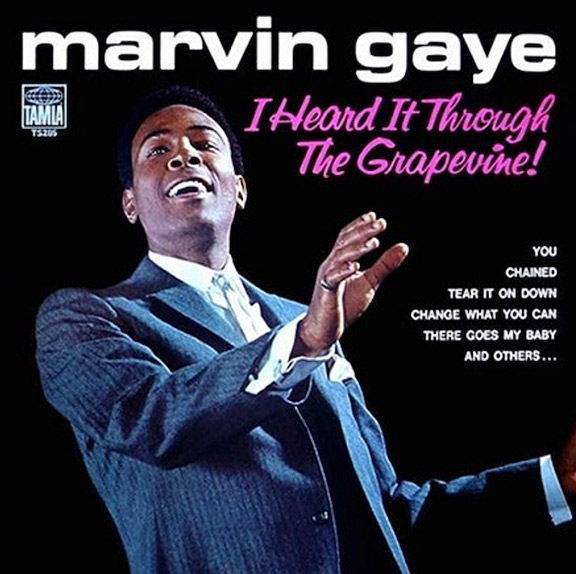
Why is Marvin Gaye’s version of “Grapevine” the one that is most identified with this tune? Some other details from the Songfacts’ article shed some light:
With this heartbreaking tune about a man who finds out secondhand that his girl is cheating on him, Marvin Gaye wrung out the emotion in the song thanks to Norman Whitfield, who produced the track and gave him very specific instructions. Whitfield had Gaye sing slightly higher than his normal range, which created the strained vocal, and he made him do it over and over until he got it right. Gaye explained: “I simply took direction, as I felt the direction he was expounding was a proper one. Had I done it myself I would not have sung it at all like that, but y’see there are many benefits in just singing other people’s material and taking directions. The job of interpreting is quite an important one, because when people are not able to express what is in their souls if there is an artist who can… then I think that is very valuable.
I’ve been in recording sessions myself where the producer makes very specific requests of the artists—sometimes running counter to the singer’s own instinct or inclination—in order to produce a particular effect. It takes trust in the producer to take that sort of advice, which is one reason that great producers are in high demand. Think of Quincy Jones, George Martin, and Sam Phillips, and you have the idea. Sometimes producers can go overboard, but in this case, it seems that Norman Whitfield knew how to elicit the best possible performance from Marvin Gaye. The rest of us are fortunate that they had this quality in their relationship.
My personal taste also tells me that Gladys Knight and the Pips—or whoever was producing their single of this song—weakened it by waiting until almost a minute in to introduce the famous bass line. With its “dum… da DUM dum” pattern, it almost feels like what people say to each other when there’s trouble afoot… and Marvin Gaye’s version starts right off with it, letting you know immediately that something’s not right.
Happy listening!
0 Comments