
Sandy and I had the exquisite pleasure of going to the Art Institute with some friends on the evening of Groundhog Day, for a performance by the period-instrument baroque chamber ensemble known as Apollo’s Fire. I had heard about this group for many years, since I’m kind of an early music wonk (“early music” meaning repertoire from the 14th to 18th centuries, not Elvis or Perry Como!). However, I’d never heard them live, and when our friends raved, we thought we should go along. The group is based in Cleveland. Recently, they have started having more of a presence in Chicago. Lucky us!
The program was called “Winter Sparks.” It included one of the orchestral suites by Bach, other music by him and by Vivaldi, a quirky piece by Marin Marais and, finally, the “Winter” movement from Vivaldi’s Four Seasons.
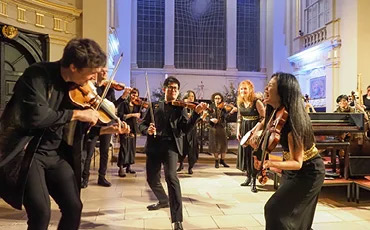
This group has been acclaimed widely. It’s so very nice when the real thing lives up to the hype. I have been around Baroque music most of my life, and I can tell you that this was one of the most spectacular performances of any kind of repertoire, early or contemporary, that I have ever heard in my life. Amazing! There were five violinists, two violists, a transverse flute player, a Baroque oboe player—the last two being woodwinds based on 18th-century models, with softer sounds and different kinds of overtones than their modern counterparts. The instrumentalists played the whole concert standing up, including the conductor/harpsichord player (founder Jeanette Sorrell), the only exceptions being the cellist and the theorbo player.
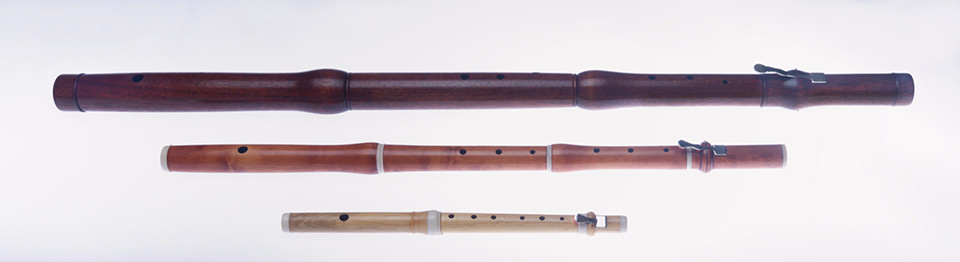
Baroque flutes were made of ivory or wood with six, small open holes plus a seventh hole covered by a single key. They produced a quieter, more intimate sound than the modern metal flute with 16 larger holes that create a louder, bigger sound.
As Sandy said later, “it was like they were dancing.” Everybody was on fire with the music. The audience was whooping and hollering out “Bravo!” and “Brava!” after the pieces were over, and there was an enthusiastic standing ovation at the end. I was high for hours afterward and couldn’t fall asleep until after midnight… way past my usual bedtime, but that’s what happens when one is completely switched on!
In our research to document the effects of our older-adult choirs on well-being, Sandy and I, along with our colleagues from Northwestern and Rush, carefully review the existing literature so that we can be up to speed on the state of the field. As part of this work, I’ve come across some studies that show that there is a positive effect on the body/mind from “just” listening to music.
The effects are more pronounced when you are making music and, for example, the hippocampus and the overall quantity of gray matter in the brain are notably larger in lifelong career musicians than in the general population.
One of the things I’m wondering now is this: does the effect on “just listening” get amplified when the performance is totally kick-a**—the way this performance was? I am not sure if people have measured that, but I’d sure be interested in finding out.
In the second half of the show, the “band” (which is a friendly and affectionate term for a chamber orchestra) was playing the Bach orchestral suite, and clearly just having so much fun that it was infectious. While this was happening, I flashed back to the time in September 2021 that my dear friend Bill Flowers and I spent two long evenings at Birdland in New York City, experiencing the greatness of the Count Basie Orchestra. We were seated in either the first or the second row—which is what happens when you are with Bill Flowers (a lifelong fan and supporter of the Basie Band, whom the band members treat like one of the family). The Basie Band tore up a whole host of jazz and swing tunes, in their own unique way and in their own musical idiom.
Hearing Apollo’s Fire play with such precision and abandon—and looking in particular at the “rhythm section” of harpsichord, theorbo, bass, and cello—I thought to myself: “Dang! These cats are just like the Basie Band, grounding the rest of the group in rhythm and harmony, and having so much fun, so the soloists can fly up top.” I realized that there must have been totally hot orchestras in the 18th century, where there was no jazz or swing yet. I realized that in the 1720s, the Baroque band was the “it thing,” the hot music of the time, the thing that made audiences go crazy! We experienced it again on Tuesday night. I can only imagine what it must have been like when Bach hired stupendous musicians to make his music come alive.
Other moments in my life like that include hearing Paul McCartney at Wrigley Field in 2011, and hearing the incredible flamenco guitar trio of Al DiMeola, Paco DeLucia, and John McGlaughlin at Mandel Hall at the University of Chicago in 1980. More emotionally restrained but still explosive concerts in my life include hearing the L.A. Master Chorale at Disney Hall singing Lauriden’s Lux Aeterna, and the day the Dale Warland Singers riveted me to my chair with Jephtha’s Daughter by Aharon Harlap; these last two were at national Chorus America conferences. And then there was the night in Vermont that I got to hear the late Pete Sutherland, a folk musician of superb chops, in a tiny rural church with two other folk-music colleagues, playing a candlelit concert whose memory still gives me goosebumps.
And you? What concert experiences have been so powerful that you still are transported to a higher place just by thinking about them? Leave a comment below, so I can get inside your musical imagination a bit more.
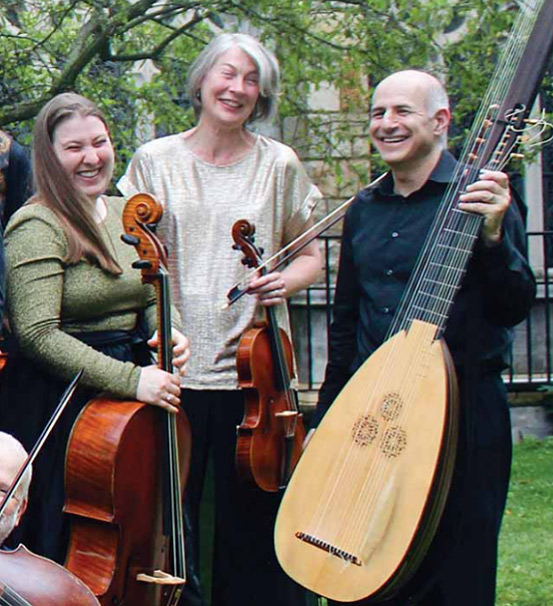
Here is William “Billy” Simms, the theorbo player (right), along with cellist Sarah Stone (left) and violist Nicole Divall (center). You can see them having fun, and they’re not even playing in this photo—but this picture captures some of the energy that we saw onstage and felt in the audience.
Having heard Apollo’s Fire perform last year, I’ve already got tix for O Jerusalem at KAM in HydePark/Kenwood on April 18. The music is a “tour” of the quarters of old Jerusalem—Jewish, Christian, Arab, and Armenian/Byzantine. Timely theme, fantastic group, sublime venue!
This reminds me of a funny experience I had 35 years ago when I was meeting my former husband’s long-term college friends for the first time. While we were sitting at a long dinner table, they were passing a joint. Both my former husband and I were/are recovering alcoholics so we passed the joint without taking a toke. Then our host asked the ice-breaker question: “What was your favorite concert.” Because they were all hippie-types, they answered, “The Stones, the Grateful Dead, etc.” (One of them was a Dead Head who had following them around the country.) Since I was nervous and feeling uncool, my mind went blank. I answered “Up With People” to be funny. The room went silent, then my former husband jumped in and talked about some band that was much cooler. Afterwards I asked him, “They knew I was kidding, didn’t they?” He answered, “Ummm, no.” It’s surprising that he married me after that! (And we are still friends.)
In the spring of 1968, I almost gave up my tickets to hear the Philadelphia Orchestra, under Eugene Ormandy, at Chicago’s Orchestra Hall. I’m glad I didn’t. The program was Weber’s “Overture to Euryanthe,” Bartok’s “Concerto for Orchestra” and Shostakovich’s “Fifth Symphony.” The latter ends with thunder from the tympani, and the audience stood as one. I have yet to hear an ovation that instant, that loud and that long.