
Leading up to our holiday concerts in December, the question I heard most often (aside from, “What’s our call time for the concert warm-up?”) is “What’s happening with the research project… aren’t you almost finished with it?”
That’s actually not an easy question to answer… sort of depends on whom you ask!
The 226 singers who volunteered to participate in our 2023 pilot study with researchers from Northwestern University’s Mesulam Center for Cognitive Neurology and Alzheimer’s Disease, and the Rush Alzheimer’s Disease Center, received the last battery of inventories (the surveys participants filled out during the Fall Session and after singing their final concerts in December 2023). As you may recall if you’ve been following our research, these inventories are the scales that measure the impact of singing in a choir on elements such as loneliness, anxiety, and purpose in life. Once the singers completed those inventories and sent them to our research assistant, Rhiana Schafer, the singers’ work for this pilot was over. And we are so grateful for how generously they gave their time and shared their choir experiences.
But for our research team—Rhiana, Dr. Borna Bonakdarpour, Jonathan, and myself—there’s still much work to be done. Starting in January, we began analyzing the results, putting them in visual form (such as graphs and tables), and started the process of writing them up in the standard form of an article for a professional research journal. The goal is to submit our article for publication by mid-2024.
Although much of this work we do separately (for example, Rhiana does data collection and analysis, Borna and I share the writing, Jonathan oversees coordination with our Sounds Good staff), our research team meets regularly and enjoys lively discussions about our findings. We talk about what our findings mean about the benefits of singing in a choir, what they contribute to our knowledge about brain health, and what should be our next project. We really like to geek out on stuff like that (note the graph we’re reviewing in a photo that Jon took of us at our last meeting)!

We’ve been working together since 2021, the four of us, and I thought I’d give you an update on the other two projects we have in the pipeline.
Starting with the very first program evaluation we did together, here are those other projects:
2021 Program Evaluation
Some of you may remember the brief survey that we sent out at the end of 2021, asking about your experiences during that year of online singing. We asked you to rate from 1 (not at all) to 5 (a great deal) how much the choir and/or sing-alongs impacted you in four areas of well-being: social, intellectual, physical, and emotional. In addition, we invited any comments about your experience.
Results showed positive improvements in all aspects of well-being (greater than 95 percent) for both choir and sing-along participants. The free responses were overwhelmingly positive (86 percent), and they revealed seven themes, with the most prominent being emotional, social, and intellectual well-being.
The results of our study were accepted as a poster presentation at the Alzheimer’s Association International Conference (AAIC) and Dr. Bonakdarpour traveled to Amsterdam to represent our team in July of 2023.
2022 Program Evaluation
We were interested in whether there was a difference between online and in-person choral singing, so we repeated a survey at the end of 2022, which was the year we returned to singing in person. In addition, we hoped to obtain more detail about the nature of well-being in each of the areas of our 2021 survey, so we expanded each of the original four questions into several questions for each area (21 items in total). For example:
“Did participation in the choir/sing-along give you an opportunity to challenge yourself?” or “Did participation in the choir/sing-along give you a sense of community or belonging?”
Our Dream Team just met last week to review the results of Rhiana’s preliminary data analysis. We have some interesting findings, particularly when we look at differences between the in-person (choir) and online (sing-along) programs, and the differences between Sounds Good and Good Memories singers. I had a hard time deciding which results were my favorites, so I asked Rhiana what she thought I should highlight for this blog. Here’s what she found most interesting:
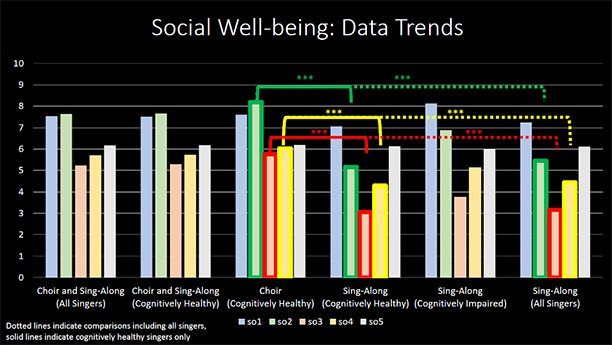
- Social well-being: Both choir and sing-along reported similarly high ratings of promoting community/belonging. However, choir was significantly more impactful [than sing-along] in forming meaningful connections with others.
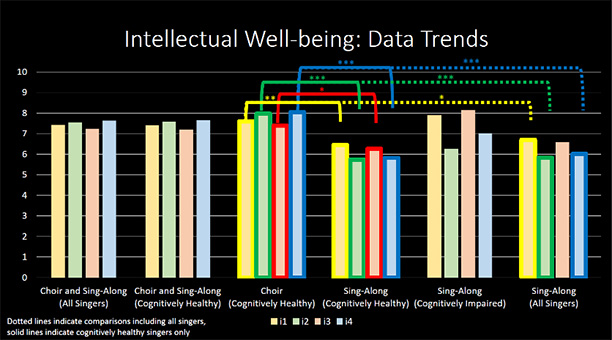
- Intellectual well-being: As expected, choir had more impact on this overall than sing-along. However, the exception is what’s interesting here—the cognitively impaired singers highly rated the importance of the sing-along as a creative outlet, more so than cognitively healthy singers who valued choir more for this.
- Physical well-being: Cognitively healthy singers reported that the choir helped them feel more in tune with their body than the sing-along program. However, the cognitively impaired participants reported a stronger benefit from the sing-along than cognitively healthy participants.
We look forward to writing up all of these 2022 findings in yet another article, and hope to see that published soon in an academic journal, as well.
Jon and I talk often about the many life lessons that Good Memories and Sounds Good have taught us, and this research venture is the latest reminder that we—all of us in this world—need each other and belong to each other. Nothing could happen without the contributions of everyone, whether it’s as a singer, a volunteer, a donor, a smile on a difficult day… or in this case, your willingness to be part of our efforts to show the scientific and medical communities the many benefits that come from being part of our singing community.
Thank you, thank you—to those who completed inventories, to those who expressed interest and enthusiasm for our research, to those who contributed financially, to those who give Jon and me a pat on the back when we need it, and to everyone who comes to rehearsal every week, braving the winter weather in some cases and braving the challenges of Zoom in others—you, who surely make the world a better place through your gift of song.
Although the results were not surprising to those of us who love to sing and especially with like minded people, it was great to have our feelings and experiences confirmed. Thank you so much to the four of you for this important work. What a blessing that Sounds Good came along at just the right time for many of us as well as the Good Memories Choir.
I also love the articles you send out to remind us of the value of group singing and Jonathan’s recent email about his early musical experiences and how affected his life. You are all the best!!! Can’t wait until next week to begin again!
Excited to see all the results of the work you have done – and, more, am excited to be part of the Sounds Good Choir 2024 Spring Concert!
This is such important research, Sandy. Thank you fir doing it and thank you for sharing it with us!
The research results “Sounds VERY Good”. Congratuations for all of your work to make this world of ours a much better place. (And we all know “The World” can use all the help it can get!) Keep this SG team of yours posted on any further results and conclusions. Thank you most wonderful people. -Ron