
– Recycling Champion, Community Activist & Intrepid Alto –
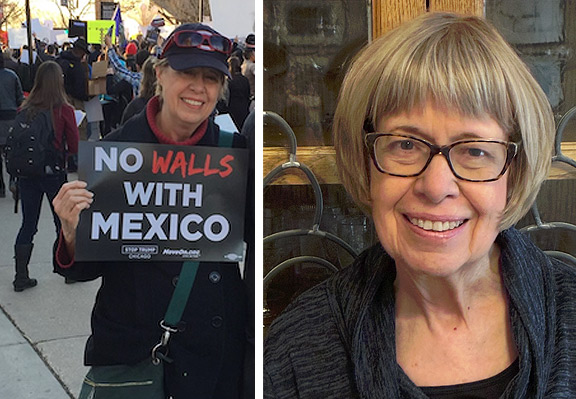
Betsy is a lifelong activist for the causes she believes in.
Some of us are fortunate to have a life-changing experience while still young enough to learn from it. For Betsy Vandercook, it happened in 1969 when she earned a fellowship to study in Germany. As an undergrad at the University of Illinois, she had “toed the line, never made waves,” and was inducted into Phi Beta Kappa. She was on a path to become a professor of German. But her year studying in what was then West Berlin “woke me up,” she says. “Every kid in the world should get out of their own country and look back at it. What did I look back at? The Vietnam War, poverty, inequality. And the students in Berlin were so engaged and political—the friends I made, the demonstrations I went to, the discussions we had (Hegel, anyone?) It turned my life around.”
Returning to the states, Betsy enrolled at Stanford, still planning to pursue a Ph.D. in German. “But what got in the way was politics. It started feeling like Berlin all over again. I got involved in the anti-war movement and joined a group that used guerilla theater as well as flyers.” In the spring of 1972 they decided to put on a performance for William Shockley, a Stanford professor and Nobel Prize winner who had embraced the universally discredited “science” of eugenics. Shockley had endorsed a proposal to pay Black women to be sterilized. “We dressed up as Ku Klux Klan members to do a little ‘friendly’ performance for him,” Betsy recounts. “We also invited the press.” Shockley didn’t appreciate the satire. “He called the police on us. It was like a movie—running across campus being chased by cops with billy clubs. They caught us, of course, since it’s hard to run while wearing a sheet. We were put on trial, which ended in a hung jury. Then Stanford threw us out.” Shockley stayed on at Stanford, retiring as an emeritus professor in 1975.
Betsy spent several years in San Francisco, then returned to Chicago to be closer to family. She married Bill Vandercook, a fellow anti-war activist, in 1977, becoming stepmom to his two young daughters. Betsy and Bill had two more children, a daughter, and a son. There are now six grandchildren ranging in age from 3 to 25.
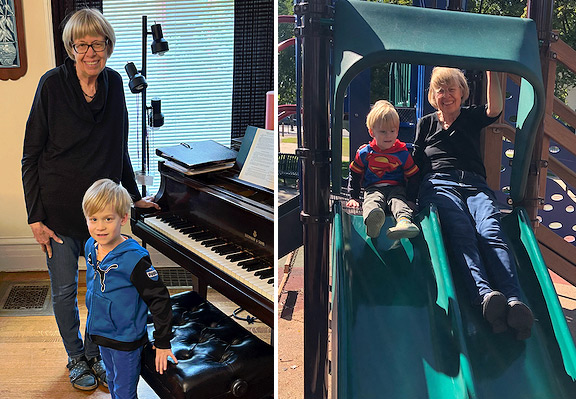
Left: Betsy and her grandson finish their first piano lesson. Right: Betsy loves spending time with her grandchildren, whether it’s teaching them to play the piano or making the most of playground equipment.
In 1980, Betsy went job-hunting. Although her plan to become a professor of German had gone astray, she did find a job in a university setting—the publications department at the University of Illinois-Chicago. Here she found a calling that would define her professional life for two decades. “There was a printing plant on site with huge 4-color presses,” Betsy explains. “We created lot of paper waste. So we started recycling.”
In 1980, recycling was a nascent movement—only about 10 percent of the waste generated in the US was recycled. But awareness was growing as landfills reached capacity. Betsy’s recycling effort caught the university chancellor’s eye, and he appointed her to head a task force to develop a campus-wide program, which he then asked her to direct. “So I completely flipped careers from publishing to recycling,” Betsy says. “I ran that department for 12 years. At the same time I joined the Chicago Recycling Coalition, which was fighting against the Blue Bag Program.”
If you lived in Chicago in the ‘80s, you might recall the Blue Bag Program—the brainchild of Mayor Richard M. Daley—which Betsy describes as “an incredibly stupid program. You bagged your recyclables in blue bags and put them in the same container as your garbage. The packer truck came by and squished it all together, and supposedly it got separated at the end. Good luck with that!” Betsy served as chair of the coalition board, but she says the fight to end the Blue Bag program was a team effort. In particular, it received game-changing support from the press. Dan Mihalopoulos, then a reporter for the “Chicago Tribune,” now with WBEZ Chicago, recalls:
“Betsy and her organization played a critical role in the demise of the failed Blue Bag recycling program. Betsy vehemently argued against what had been touted for years as a key ‘green’ initiative of the Daley administration. This was at a time when few, if any, elected officials in Chicago would dare to publicly criticize the mayor for anything. The criticisms from Betsy and other environmental activists allied with her group were what prompted me and [fellow reporter] Laurie Cohen to investigate the Blue Bag program for the “Tribune,” and we exposed just how unpopular and misguided that approach was. Chicago homeowners owe a measure of thanks to Betsy every time they can fill their recycling bins just as people in the suburbs were doing long before them.”
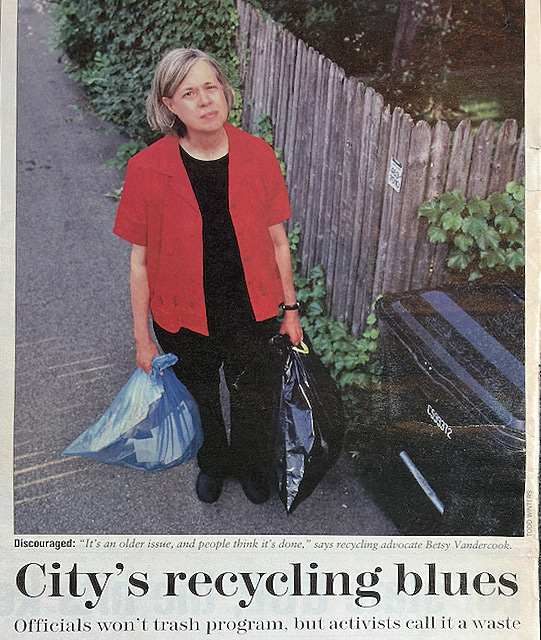
In July 2002, “Crain’s Chicago Business” pictured a “discouraged” Betsy Vandercook, holding a blue bag who said, [The Blue Bag program] “is an older issue, and people think it’s done.” But she and others pressed on for six more years until the City canceled the program and converted to blue carts for recycling.
Having “done what I wanted to do,” Betsy moved on, this time to an eight-year stint as chief of staff to 49th Ward Alderman Joe Moore. There she also broke new ground, this time with a then-new practice called participatory budgeting. “Our ward was the first political entity in the U.S. to do it,” she says with pride. Participatory budgeting gives residents of a political unit a voice in deciding how a portion of public funds will be used. In Chicago, that figure is $1 million per ward each year. “A lot goes to bread-and-butter issues, like repaving streets and alleys,” Betsy explained. “But you have a portion left for more interesting things, like painting murals on viaducts or constructing a new park playground.”
In 2017, Betsy left the 49th Ward post after what she terms a “career-ending disagreement” with Alderman Moore over public education issues. But she remained active in the neighborhood, including serving on the Kilmer Elementary Local School Council, where she was instrumental in securing $7 million to renovate the building, as well as starting an International Baccalaureate Program. She also serves on the board of Lifeline Theatre, which creates original plays from books. “It’s been a joy,” she says, “But times are tough for theaters. So instead of one meeting a month, it’s at least two a week.”
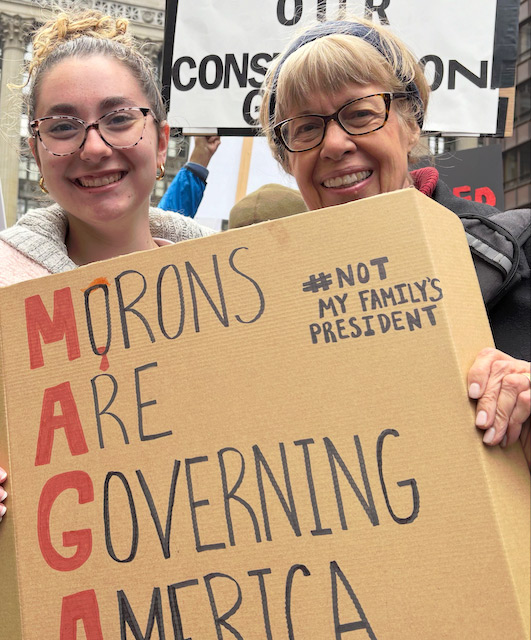
Protests are a family tradition. Betsy and her granddaughter, Eliana, keep it going during the April 2025 March in downtown Chicago.
Amid her civic activity, Betsy makes time for grandparenting—attending concerts, sporting events and graduations. Then there’s the singing. She heard about the Sounds Good Choir from her friend and former UIC colleague, Marianne Schapiro. Betsy attended the first rehearsal of the Evanston choir and has been singing ever since. Then last spring her friends Bruce Calder and Elspeth Revere invited her to join them at a Good Memories rehearsal. “So I did, and I loved it.” Always an alto, Betsy feels particularly useful in supporting singers in her small section. “But with only about 10 of us, I’m really aware of the challenge to try to not make mistakes. It’s certainly not pressure from Jonathan [Miller], but by the end of a concert I can tell you exactly what notes I blew. But I can also tell you how happy and exhilarated I am to have made harmony together with my singing partners!”
Elspeth Revere, her friend for 40 years, says of Betsy, “I have been touched by her decision to volunteer at Good Memories, at least in part so that we can see each other every week. She has also befriended my mother, now age 96, who moved to Chicago three years ago. Betsy is an important member of my support network and closer than most of my family, though she feels like a family member because we have been friends for so long.”
Betsy’s musical pursuits aren’t confined to singing. She studied classical piano through her first year college and again as an adult at the Old Town School of Folk Music (where Bill works). But the most fun, she says, is getting together with relatives at Thanksgiving to form a family orchestra with Bill on recorder and harmonica, sightreading their way through a book of holiday songs.
Asked if there is anything in her five-decade career of service and activism that she might want to do over, Betsy replies with a firm “No,” adding, “Everything was an adventure that in turn opened a new window. But to be clear, I didn’t accomplish anything alone. I was always working with a group of people, from an organization to a block club to a ward. One person can’t really do anything—you can’t stop a war or improve a school or build a playground. And to bring it all home, one person singing alone can’t be a chorus.”
Wow! Thanks for introducing me to a wonderful person!!
Bravo! Such an inspiring story?