
One of my dear friends and professional colleagues is Dr. Barbara Fiese, a clinical psychologist and academic researcher. Barb and I met the year that we were the two clinical, pre-doctoral psychology residents in the departments of Pediatrics and Child Psychiatry at Rush Medical Center. At the end of an intense year of long workdays and incredible experiences, Barbara took a job at Syracuse University and we began a lifelong, long-distance friendship. Her very successful, 35-year career in academia, including her promotion to chair of the psychology department, was vastly different than my focus on clinical work—first on medical staff at Rush, and then in my private practice—and we often joked about the “joys” of our career choices.
One of the common complaints that I heard from Barbara was the grind of “publish or perish” in academia. One’s career there depends on having your research published in peer-reviewed journals, with higher-ranking journals more of a prize than lesser ones. The publication process involves many steps, such as analyzing your data; submitting a lengthy, detailed write-up of the project to the journal; having it assigned to a team of reviewers; and awaiting their feedback. If you are lucky, your manuscript isn’t rejected outright (and the majority of submissions are) but, instead, the reviewers ask for edits and invite you to re-submit within a prescribed timeframe. It’s not unusual to go several rounds of that. Barbara once jokingly said that, after receiving so many similar letters from journal editors, she sometimes felt like her new name ought to be: “Dear Dr. Revise-and-Resubmit Fiese”!
I mention Barb’s story because the Sounds Good Choir/Northwestern research team found ourselves deep in the publish-or-perish world when we submitted our first project for publication (about our 2021 online programming during the COVID lockdown), in 2024. Our manuscript was submitted to the Journal of Alzheimer’s Disease and survived three major rewrites before being published in May, 2025.
Our research team had a celebratory dinner, during which much of our conversation focused on the schedule of preparing the manuscript of our 2023 project for—Here We Go Again!—publication.
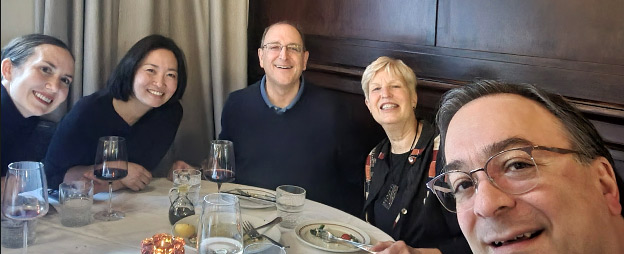
The Sounds Good Choir/Northwestern research team: (Left to right) Aimee Karstens, Ph.D., Neuropsychologist, Rush Alzheimer’s Disease Center; Clara Takarabe, CSO Violist and Co-Director, NU Music and Medicine; Jonathan and Sandy Miller, Sounds Good Choir; Borna Bonakdarpour, M.D., Associate Professor of Neurology, Northwestern Medical Center.
The 2023 study was our first systematic look at the effects of choral singing on the well-being of older adults. The participants in our study agreed to complete a battery of inventories (research scales) that assessed anxiety, loneliness, positive/negative affect, purpose in life, psychological well-being and perceived social support. Singers (169) from both Sounds Good and Good Memories choirs, completed these inventories three times: (1) one month before our fall session, (2) right after the first week of the fall session, and (3) one week after our December concerts. Our goal was to see if there were any differences—hopefully positive changes—between the beginning and the end of our 15-week session.
Here’s a brief summary of our results:
1. We found positive changes on all six of our outcome measures, with two of them (State Anxiety and Negative Affect) reaching statistical significance. Singers were significantly less anxious and had fewer indications of low mood after the 15-week choir session.
2. 96% of our singers showed improvement on at least one of the other four measures: Loneliness, Sense of Social Connection, Purpose in Life, and Psychological Well-being.
3. An interesting finding was that the baseline (level of functioning before we measured anything) was very high in our population. Our singers were already low in loneliness, anxiety, and depression. They already had a solid sense of life purpose, well-being, and social connection.
4. And many of our singers had been singing with us for years! One of the interesting features of our manuscript is to document this phenomenon and raise the question of how much the years of singing in a choir has contributed to these great outcomes.
5. The results support the need for an increase in community-based choir programs for older adultsin order to make choral singing more available.
Once again we find ourselves in the happy situation of preparing yet another manuscript for publication. I’m truly hopeful that this time we can go fewer than 3 rounds of “review and resubmit”! And we’re already asking ourselves, “What’s next?” and envisioning our next project.
There are a number of cool things about doing research. Getting positive results is one of them, for sure. And sharing those results with the world through a publication is even better. But taking a critical look at our research project and allowing it to inform what comes next is also one of the joys of research. It’s good science to ask ourselves, “what can we add to a subsequent study and what can we do better?” We learned a lot from our 2023 study that will have us tightening our methodology, tweaking the inventories that we use, and hopefully adding a biomarker (a physiological measure of the effect of singing), so that our next research project is of higher quality and contributes something new to this fascinating scientific “conversation” about the benefits of singing.
It is our hope that this study and our future research will support the need for investment in community-based choir programs for older adults and for older adults with cognitive challenges.
Thanks to everyone who made it possible for our Sounds Good and Good Memories Choirs to do this important work.

You can see the happiness radiating from members of the Hinsdale Sounds Good choir at their Summer Rocks concert in 2025.
Thanks for sharing this timely information — ALL is SO True!
Truly a fascinating project and wonderful results. One question: How did you control for the “caregiver “ effect? How does the presence of a caregiver contribute to the effects seen in the study?
Thanks for sharing! You have identified two of the super-challenges you face in getting “evidence” that the choirs work: have so little variability in well-being in the folks in the choirs, and having measures which are not fine-tuned enough to capture what you need. You probably already have it, but a nice recent report is in the March, 2026 Monitor on Psychology “Music and the Mind: What the science of music reveals about cognition, emotion, and identity” . More folks who are seriously interested in how music, in all cultures, affects our feelings and cognitions.
Congratulations on finishing your extensive work and getting it published. Great job persisting !