
Writing about this song is great fun. This song has a history with Sounds Good Choir, which will be performing it at our tenth anniversary concerts in May 2026. I’m going to tell you three big things about “Fly Me to the Moon”: how and when it was first written and recorded; who turned it into the bossa nova-style song that we think of today; and the story of its hilarious send-up on Sesame Street. All in one tune… now that’s quite a ride!
The arrangement of “Fly Me to the Moon” for choir that’s in our repertoire is by Kirby Shaw, one of the great vocal-jazz arrangers of our time. Our first experience with the tune was back in the spring of 2017—our first full 15-week spring session. We had six older-adult choirs at the time. (At the time, our ensembles were called Encore Chorales, since our just-born nonprofit was named Encore Illinois). Linda Crabtree Powell, who’s celebrating ten years on our conducting team, led her ensemble in Oak Park that spring, as she still does today. Yours truly, running around the Chicago area like a crazy man, conducted the other five groups. (I had a bit more energy for that rehearsal schedule, and certainly more hair, then.) Sandy Siegel Miller, my spouse and our co-founder, was working 20 hours a week as our unpaid operations director while running a fulltime practice as a clinical psychologist.
Since people associate this tune with travel, I’ll tell you that Wednesdays when I conducted our choirs were especially exciting from a transportation standpoint during the spring of 2017. I would take the Metra downtown and then the No. 28 bus to Hyde Park to rehearse the choir at Montgomery Place. Afterward, I’d hop on the No. 6 bus, then the No. 14, and transfer to the Northwest Metra line to Arlington Heights, where Sandy would meet me, sing alto or tenor as needed, and then drive us home to Downers Grove. Megan Bradley was our cheerful intern, helping us to keep the whole thing running. Since this song is about space travel, one might use a similar metaphor and say that we were building the spaceship of our choral organization and flying it at the same time. We now have many more conductors (and choirs), and the travel schedule is a little easier for most of us, although I think Amy Wurtz could use a spaceship as she handles three Sounds Good rehearsals every Monday!
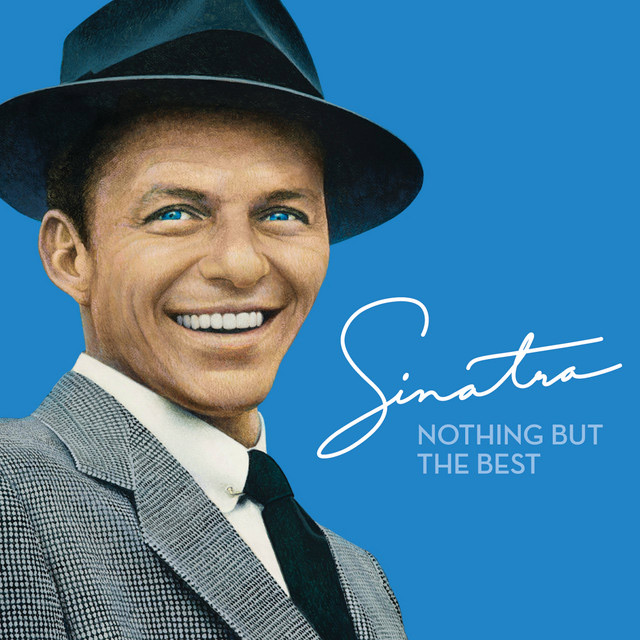
Old Blue Eyes, himself, made “Fly Me to the Moon” the iconic hit is today and sent it into lunar orbit with Apollo 10’s mission in 1969.
Bart Howard, who wrote “Fly Me to the Moon,” said that “… it took me 20 years to find out how to write a song in 20 minutes.” Have you ever had an experience like that? I have. The idea is that one’s craft—in this case, songwriting—takes much of a lifetime to get it to the point where it looks easy. It can take decades of unglamorous, hard work to get one’s handiwork refined to the point where, on a day when the stars all align, one has the talent, skills, focus, wherewithal, and sheer luck to pen a hit. My version of that came a year ago, when I wrote the melody to “Yehi Or Chanukah” in a relatively short time after getting the words right.
Mr. Howard was a seasoned songwriter by 1954. Cole Porter was his role model for both lyrics and music. Because Howard was used to the intimate settings of New York nightclubs, where he worked as an emcee and intermission pianist, his songs have been praised for their intimate quality. James Gavin wrote that Howard’s songs “were made to be sung in small places […] They defined the word ‘intimate’.” Howard himself wrote:
My songs are about love […] I always approach the writing of lyrics with a kind of smiling compassion for the poor creatures who keep trying to cope with this dear devil emotion. And, since words alone cannot tell the tale, I aim for melodies and harmonies that betray the anxieties behind the casual lyric observation.
Howard was starting to get some recognition for these love songs in the early 1950s. Rosemary Clooney recorded his tune “On the First Warm Day” in 1952.
Two years later, the singer Felicia Sanders—who worked with Howard at the nightclub known as the Blue Angel—debuted his tune known originally as “In Other Words” at the club. Later that year, Kaye Ballard gave the tune its first recording in 1954.
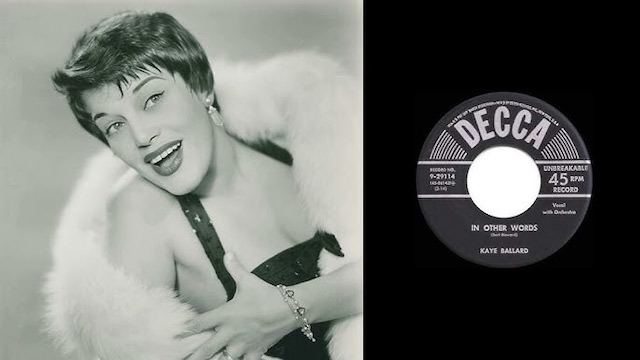
Kaye Ballard’s “In Other Words” on Decca Records released in 1954.
Listen to this! Two things jump out at me: first, it’s a waltz, not a bossa nova; second, it’s got one of those clever introductions at a different tempo before launching into the “main” part of the tune, which is the only part that survives in our choral version.
The song got a big bump when Peggy Lee sang it on the Ed Sullivan Show in 1960. Peggy Lee’s version is also a waltz and has the whole intro section. But the song was not to last in that form.
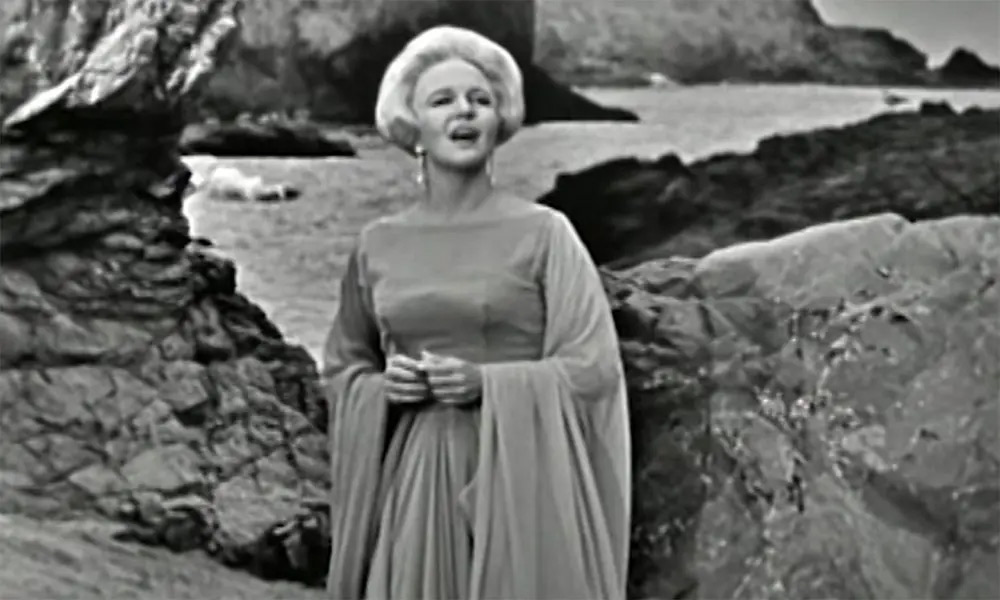
Peggy Lee performed the song as a waltz on The Ed Sullivan Show in 1960.
Joe Harnell and The Bossa Nova Pops recorded the tune in 1962 as a sort of jazz orchestral thing, and it went to No. 14 on the pop charts the next year. Harnell dropped the opening “patter” section in favor of a stronger opening right on the “Fly Me to the Moon” section. In fact, since the Harnell version, the tune has been known as “Fly Me to the Moon” instead of “In Other Words.”
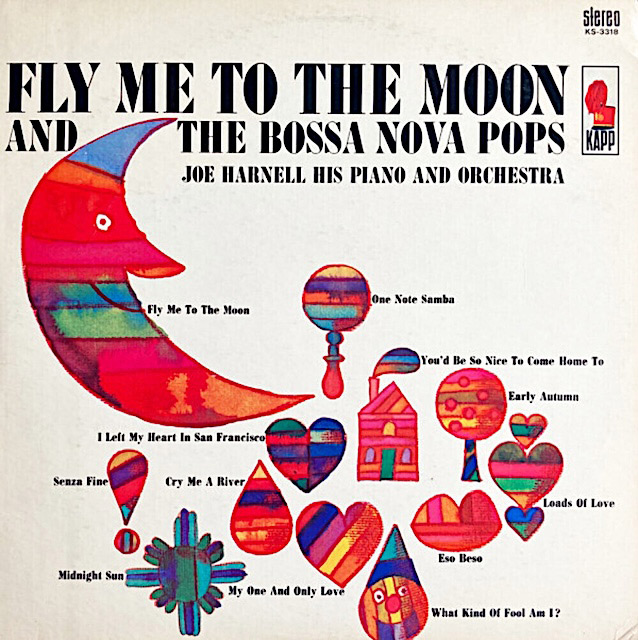
Joe Harnell and the Bossa Nova Pops gave it a bossa nova feel with a stronger opening on the “Fly Me to the Moon” section.
The big event for the tune came two years later when Frank Sinatra recorded it with the Count Basie Orchestra. And here is a fabulous live recording of Basie and Sinatra laying it down in St. Louis, at the Kiel Opera House:
You can hear Sinatra’s superb rhythmic work, where he delays coming in and then speeds up the tune to sync up (mostly) with the rhythm section. It’s just brilliant singing, and you can see in his face how much fun he’s having. Here it’s a straight-ahead swing, not as much of a bossa nova feel as Joe Harnell’s group had going. Sinatra’s version was important enough in popular culture to be recorded on a cassette tape that accompanied the lunar orbit of Apollo 10 in 1969. His recording has long been associated with space travel.
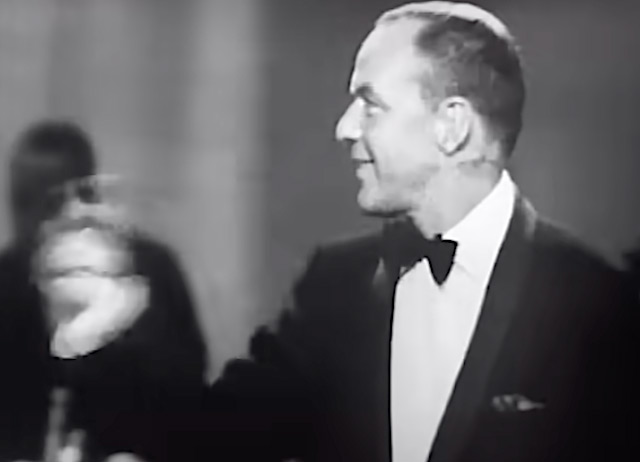
Sinatra memorably performed the song with the Count Basie Orchestra, and here with Basie in the Kiel Opera House in St. Louis.
In 1965, at the age of 39, Tony Bennett—in the prime of his amazing vocal career—recorded the “Fly Me to the Moon,” this time with the opening section. Bennett sang it as a slow crooner ballad, with glorious, long, legato notes and gorgeous vibrato and technique. (His arranger, Don Costa, added a backup choir, which I’m not crazy about.) The tempo is a very slow 4-pattern, giving the singer just enough scaffolding to spin out unbelievable lines. His version peaked at No. 84 on the Billboard Hot 100 chart, while the album itself made it to No. 34.
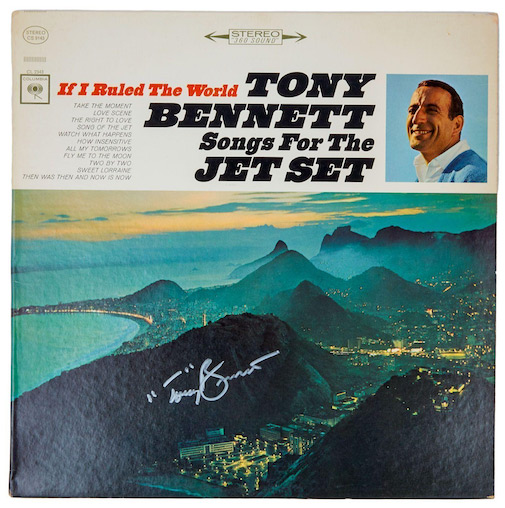
In the prime of his vocal career, Tony Bennett sang “Fly Me to the Moon” with the opening section and… a backup choir!
I promised you a funny final story, and here it is: In 1998, Tony Bennett made a guest appearance on Sesame Street, singing a spoof version of his big hit. Oscar the Grouch had a pet worm, who was named Slimey. The two of them wanted to go into space for a long time. In 1997, the show’s producers created a multi-episode story arc in which Slimey would get interested in space travel and finally get to do it. As you can see, Tony Bennett had a great time on the show, with the new lyrics.
In closing, I’ll refer you to the performance of our same choral version by the Home Choir, a group of people who practice at home (all over the world, although the choir is based in the UK) and send in recordings, just as singers from Sounds Good Choir and Good Memories Choir did during the Covid lockdown. It’s amazing what technology has allowed us to do. The Home Choir recorded Kirby Shaw’s bossa-nova choral chart for World Alzheimer’s Day. Here you go:
Happy listening, and if you’re not already in one of our choirs, come hear us sing this tune at our May concerts. You can find details on attending the concerts on our Concert Schedule page on our website.
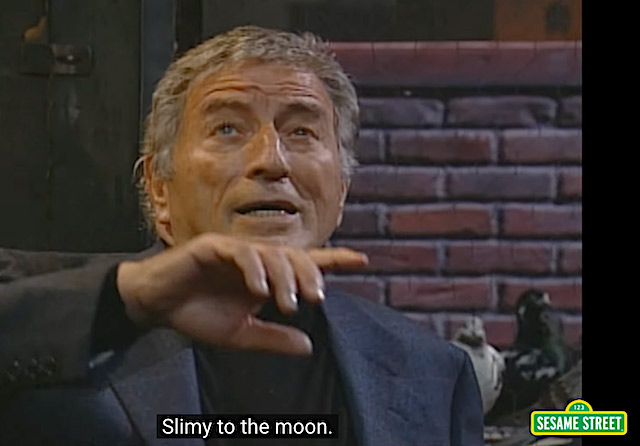
Bennett also had fun singing modified lyrics for a Sesame Street skit about a worm astronaut, in “Slimey to the Moon.”
You are right. That chorus in Tony’s version is really weird. Like it was laid on top of the song. Thanks for the interesting insight.
I love the information and listening opportunities you give us in these blogs. Thank you.