

A detail from The Meeting of St. Ursula and the Prince Etherius. Sitting at the top corner of the painting, this detail shows six wind players of Black ancestry performing on the balcony. From the multi-panel St. Auta Altarpiece, early 16th c., housed in Lisbon’s Museu Nacional de Arte Antiga. There are no known portraits of Vicente Lusitano. (Photo courtesy MNAA)
In honor of Black History Month, Sounds Good Choir is highlighting the contributions made to music by individuals from the African and Black Diaspora—as composers, musicians, singers, conductors, lyricists, historians, musicologists, publishers, and producers, starting with Vicente Lusitano, the first Black composer to have his music published.

Joe McHardy: Conductor, composer, musician, and early music scholar.
Overlooked for 500 years, the music theory and choral works of African-Portuguese composer, Lusitano, are only now being lifted out of obscurity… due, in part, to the efforts of Joseph McHardy, a Scottish-Congolese musician, conductor, and early music specialist.
In 2020 McHardy saw a tweet by American flautist and composer, Alice H Jones, of the protest placard she carried at a BLM march in New York; Lusitano’s name was listed with other black classical composers whose contributions have been more or less omitted from history books. McHardy thought it strange that, as a scholar of early music, he had never heard of the Renaissance composer. Intrigued, he started researching Lusitano, and uncovered a wealth of motets, music theory, and musical treatises, including 23 motets published in Liber primus epigramatum. Unfortunately, no modern editions of any of his compositions existed.
Born in a small town outside of Lisbon in 15, Lusitano was ordained as a Catholic priest and went to Rome where it’s believed he tutored the family members of a papal ambassador to the Vatican because, being Black, he was ineligible for a church posting. Later, he moved to Germany, where he composed music and liturgy for the Protestant ducal court in Stuttgart.
“Excluded from the opportunities that would have come with a church position—a place to showcase his music, scribes to copy it into choir books—Lusitano struggled to leave us traces of his life,” writes McHardy. “Lusitano, the Black master musician, writing and teaching counterpoint during its golden age,” McHardy continues, “shows us how selective music history is in who it remembers. Palestrina, Lassus—men with patronage, access, and influence—these would become the Renaissance giants whose music was later pored over.”
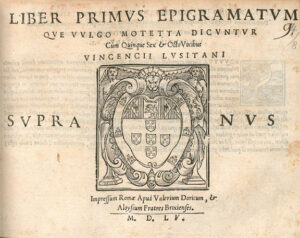
“The title page to the soprano’s part of Lusitano’s motet collection Liber primus epigramatum (1551). (Photo courtesy of Early Music America).
Lusitano and his work were relegated to the dusty peripheries of musical archives not only because he was Black (and so lacked the status typically afforded scholars and musicians of his caliber), but also because a philosophical disagreement with one of his contemporaries grew into a bitter feud. After losing a public debate about music theory—adjudicated by none other than senior Vatican musicians—a jealous rival, Nicola Vicentino, having more powerful, aristocratic connections and thus easy access to printing, widely circulated a narrative that not only misrepresented, but effectively suppressed, Lusitano’s scholarship; centuries passed before music scholars uncovered Vicentino’s deception and began reviewing Lusitano with fresh eyes. Philippe Canguilhem, a musicology professor at the University of Tours in France, said “I have always been shocked by the paradox between the quality of Lusitano’s accomplishments and how little we know about his life.”
Determined to hear the work performed, McHardy spent months creating his own versions of Lusitano’s compositions from scans of sixteenth-century originals. In the summer of 2022, he conducted the a cappella group, Chineke! Voices in performing Lusitano’s choral works as part of a performance for Live from London in beautiful St Martin-in-the-Fields.
Since McHardy and others made Lusitano’s work available, Lusitano’s works have been performed around the world; Lusitano’s Inviolata—an eight-part motet, was recently performed by the Marion Consort, conducted by Rory McCleery. who wrote, “…Lusitano preserves the plainchant-derived canon at the heart of the motet, spinning mesmerising webs of polyphony around it which culminate in the almost hypnotic waves of repetition that begin the final section.”
As for bringing this Renaissance composer out of the shadows, McHardy writes, “Composers such as Lusitano help us to listen more carefully, to hear Black voices, present for as long as there has been such a thing as classical music.”
0 Comments