
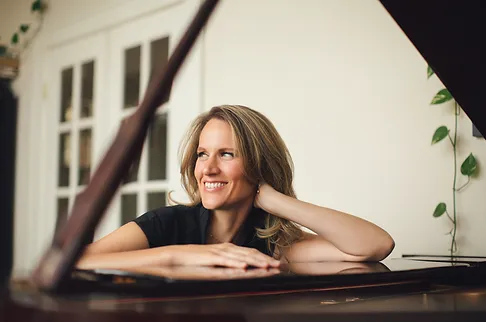
Amy Wurtz – ensemble pianist, composer, teacher and leader in Chicago’s New Music scene – and a key part of Sounds Good Choir’s success.
Sounds Good accompanist and conductor Amy Wurtz was literally present at the creation of Sounds Good when the first two choirs were launched in Evanston and Hyde Park in April 2016. Her role has expanded along with the choirs: she’s at the piano for the Good Memories choir in Chicago, the Northbrook Sounds Good choir for the Summer Rocks session, and she often doubles as a conductor. Amy also leads the Friday Sing-along Cafés, alternating with Paul Langford.
But if that’s all you know about Amy Wurtz, you are missing about 75 percent of her musical enterprise. She is a solo and ensemble pianist, a composer, a teacher, and a leader in Chicago’s vibrant New Music community. She combines all of these roles brilliantly in her Women’s History Month project, which is concluding this week. Every day in March, seated at the piano in her living room, Amy performs a piece by a woman composer, then gives a short talk about the composer and her work. Florence Price, Betty Jackson King, Irene Britton-Smith, KC Ginther, Regina Harris Baiocchi, Augusta Read Thomas, are among the composers Amy is highlighting. Although Women’s History Month is drawing to a close, you can catch the entire month’s selections on Instagram, Facebook, or on her YouTube channel. You can also attend the free closing concert and celebration in person on April 7, at 3 pm. Learn more here.
Choosing composers to feature in the history project is both a pleasure and a challenge for Amy. “I want to have a really wide-ranging representation of historically diverse composers,” she explains. “I have a strong focus on Chicago—women who are from here, or are working here. Also, I want to show diversity in terms of race, ethnicity, and countries of origin.”
Amy also presents a wide variety of styles and genres. “I want to offer a full spectrum of what’s out there—a variety of pieces, some lighter, shorter, more tonal. Some of the recently composed pieces are more unusual.”
Asked to reflect on the challenges facing women composers today compared to their 18th and 19th century predecessors, Amy says there are some similarities. Citing Clara Schumann’s oft-quoted statement, “A woman must not desire to compose,” Amy says that even though the quote is often taken out of context, “it resonates with me. There are opportunities I can’t take because of my responsibilities as a single mom. But on the other hand, I’ve never felt looked down upon, or that I have less of a chance than a man in an overt situation.”
Amy’s body of work to date includes three string quartets, a set of songs, various orchestral, choral and chamber pieces, “and tons of piano pieces.” Does she see her work advancing? “I hope so,” she says. “Composers have distinguishing features in their music, and I feel that there are some in my music. But I also feel like I want to move toward a new period. There is self-doubt. It’s a lonely endeavor.”
Despite recent attention to works by women composers, both living and dead, Amy notes that their works still constitute less than 10 percent of what’s being programmed today by major orchestras. Like many of her contemporaries, Amy finds opportunity in the expanding world of New Music, as both an artist and a leader in the Chicago community. She is a board member and former president of New Music Chicago, which is bringing back the Ear Taxi Festival next year after a four-year hiatus. Amy serves as curatorial director of the event, which will focus on the collaboration between vocal and instrumental music. Keep up with plans for the 2025 festival at the Ear Taxi Festival website.
You can also catch Amy in performance at the annual Thirsty Ears Festival, sponsored by Access Contemporary Music. The festival typically takes place the second weekend in August. Check the ACM website for updates.
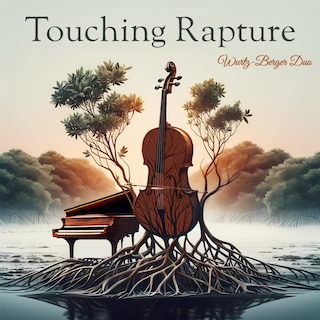
As if all of these pursuits aren’t enough, Amy is also one-half of the Wurtz-Burger Duo with cellist Alyson Berger. Their new album, “Touching Rapture,” was just released, and will be available on CD and streaming platforms. The release party is set for Sunday, May 5, at the Green Mill. Get the details on Amy’s website:, or feel free to ask Amy for a CD when you see her at a Sounds Good rehearsal!
When not performing, accompanying, composing, or practicing (4-6 hours a day), Amy is encouraging future musicians in her piano studio. “Teaching is a big part of what I do,” she says. In addition to helping them develop their piano skills, Amy invites her students to write their own music. “I have a number of kids who really enjoy composing, and it’s so fun to see how they develop through the years. Every year for my “Composer Discovery Project” I pick one composer, and each student plays a piece by that composer, as well as researching her or his life. Then the students each write a piece. I work with them in their own style. I never try to hide the fact that it’s hard.”
This year’s project features Wynne-Anne Rossi, a Minnesota-based composer whose work will be featured in the March 30 Women’s History Month segment.
Amy’s household includes two young musicians, daughters Greta,15, and Elsa,12. Not surprisingly, both are following in their mother’s footsteps—at least for now. Greta is a cellist, and Elsa plays piano and clarinet. Amy has no plans for them to become musicians—they each have their own ideas about their futures—but she does insist on keeping music in their lives as a vital part of their education and for all it does to enrich their developing minds.
Like so many musicians, Amy’s pursuit of her passion involved copious amounts of blood, sweat and tears, with an occasional infusion of serendipity that encouraged her to continue to follow her dream. One such encounter was a phone call from Sounds Good co-founder Jonathan Miller inviting her to sign on as the accompanist for the first two choirs.
Reflecting on his good fortune in making that phone call, Jonathan said, “Amy brings a composer’s ear and mind, a roll-up-your-sleeves attitude with tremendous flexibility, the useful perspective of a self-described ‘non-singer’ who understands the challenge of having to negotiate a voice part, the ability to improvise and change plans when needed, complete reliability, and a great sense of humor!”
For her part, Amy characterized that phone call as “one of God’s great blessings. The timing was so perfect. My life was changing, I was going through a divorce, my kids were four and seven. Then I get this phone call out of the blue.”
While divine inspiration may have been a factor, it is Amy’s talent, dedication and drive that have made her one of the most valuable contributors to the success of the Sounds Good Choirs.
Amy is a wonderful asset to Sounds Good. I’ve gone to a few rehearsals she’s done online and they were helpful. But…the real blessing of Amy for me is how she does her Sing-Alongs. She always plays something I’ve never heard before from familiar artists, and she never misses my favorites. Her research is in-depth and she shares so much about the Siing-Along’s subject’s life and music, it’s a wonderful mix of learning and singing. Thank you to Amy!
Very impressive! Given her many accomplishments (and with the promise of many more in her future) Amy is quite a catch for the Sounds Good Choir. And thank you, Helen, for introducing us to the person behind those accomplishments. Your article bridged the space between musician and audience, so we can appreciate Amy’s gifts even more.