
If you used your powers of visualization to imagine the personality, look, and temperament of the person who wrote all of the music for the 1968 counter-cultural Broadway smash “Hair,” what sort of person would you see in your mind’s eye? Take a moment and try to do that.
And now, the big reveal…
Believe it or not, the guy who took the way-out lyrics for “Hair” and set them to music was a strait-laced man named Galt MacDermot. At the time of the show, he was almost 40 years old, had short hair, wore a shirt and tie, and neither smoked marijuana nor drank alcohol— the virtual opposite of a hippie.
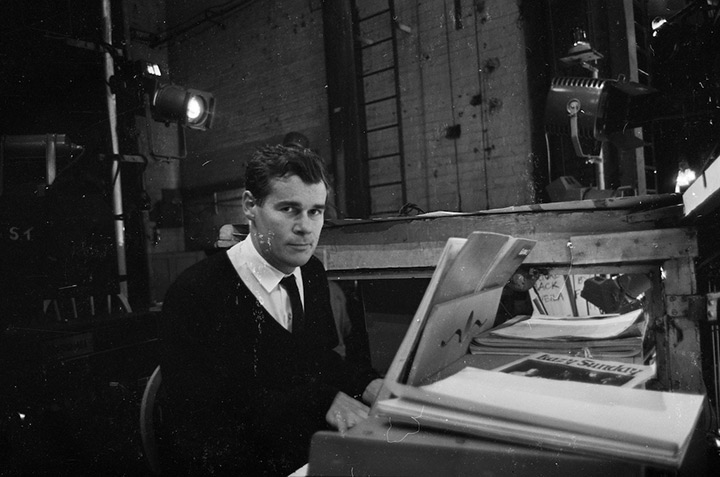
Strait-laced as he may have looked, Galt MacDermott thoroughly captured the zeitgeist of the 1960s counterculture with his infectious beats and harmonies.
Arthur Terence Galt MacDermot (1928–2018) was born in Montreal, the son of a historian/diplomat father and a mother who came from a distinguished Canadian family. His father served as Canadian ambassador to Greece, Israel, South Africa, and Australia. After college in Canada, Galt went to South Africa to study, where he specialized in African music. I’m imagining that he was one of the first North Americans to take African music seriously, and he clearly did so from a performer’s point of view.
After meeting his wife Marlene Bruynzeel in South Africa, they returned to Canada in 1954 and married in 1956. MacDermot played piano in jazz clubs and was organist-choirmaster at a church until 1961. The lines between genres were not drawn as thickly as they are now, and it was easier then for good musicians to move around and play all sorts of different things. (I was interested to learn that this kind of genre-jumping happens a lot more in New York than in Chicago, but that’s a topic for another blog.) His children recalled in later years that he was very disciplined while working at home when they were young, going to his piano every morning to write; when the new music wasn’t coming, he would play classical repertoire to keep fresh and to keep his fingers moving.
In 1957 MacDermot wrote some of the music for a revue produced at McGill University, where his father had taught. “My Fur Lady, the Red and White Revue” proved so popular that it toured nationally in Canada for more than 400 performances in 1957–58. Perhaps prophetically for “Hair,” this revue has been called “a satirical look at the Canadian Establishment,” and musically it was an eclectic mix of rock, jazz, and sentimental-sounding tunes.
While in Cape Town, MacDermot had written a tune called “African Waltz.” This piece was recorded in 1961 by Cannonball Adderley, the great American alto saxophone player. British saxophonist John Dankworth did a well-known recording as well. Adderley’s recording won a Grammy that year for best jazz and best instrumental composition. Clearly there was a big talent here in the unassuming Mr. MacDermot.
MacDermot and his young family spent 1963 in London and then settled in New York a year later. He played in studio and R&B bands and must have gotten his name around a bit. The following year, the lyricists for “Hair” started writing the show—the unlikely duo of romantic introvert James Rado and wild, extroverted Jerome Ragni. The plot was essentially about their stormy friendship, playing out at a time of huge social and cultural upheavals. The two were doing well writing lyrics but had trouble finding a composer. They had shown some lyrics to Herbie Hancock, but he ended up making too many cuts to the lyrics and it wasn’t a good fit. Nat Shapiro, the jazz writer and producer, introduced them to MacDermot and the lyricists were thrilled. As the New York Times quoted in MacDermot’s obituary, Rado said, “We loved what we heard. The music fit like a glove. Galt set the words down exactly as they were on paper. We were very happy for someone not to be editing our stuff.”
What a funny combination of people! MacDermot said, “I had short hair, a wife, and, at that point, four children, and I lived on Staten Island. I never even heard of a hippie.” But the music came quickly, with a first set of songs appearing in three weeks.
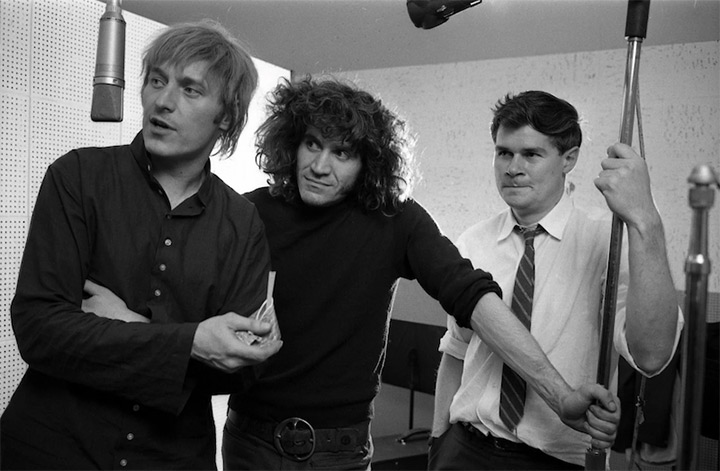
Galt MacDermot, far right, with his HAIR collaborators Gerome Ragni, center, and James Rado, left. Circa 1968.
There’s even a local connection to the genesis of the song, “Let the Sunshine In,” which we’re singing in our July concerts. In case you’re not singing with us this summer, we’re closing our concerts with a choral setting of the version that’s mashed up with “Aquarius,” in the style of the Fifth Dimension’s recording that hit No.1 on the charts in 1969 and won Record of the Year in 1970. The original production at the Public Theatre did not end with “Let the Sunshine In;” indeed, the original ending to the plot was rather hopeless and bleak. The producer Michael Butler—who came from a wealthy family, the same people who owned the land that is now Oak Brook, in the western suburbs of Chicago—acquired the rights to the show after seeing “Hair” off-Broadway in 1967. He had become an anti-war advocate earlier in the year, abandoning his ambitions to run for the U.S. Senate, and he threw himself into the stage world. With the rights in hand, Butler orchestrated the show’s move to Broadway. During the move between venues, the decision was made (championed by director Tom O’Horgan) to end the musical at the Biltmore on an upbeat note. MacDermot wrote the music for this majestic and inspiring final anthem during the transition to the Biltmore Theater.
The story is told by Eric Grode, who wrote a 2010 book on “Hair,” that MacDermot’s score worked well partly because it was so flexible. In the heat of a production, actors sometimes wouldn’t come onstage on cue, and the music had to keep going! In a more rigidly written score, this would have been a problem. Because of the way MacDermot wrote, however, the pit band could just play the opening riff a few more times until everyone got on stage. Grode also notes, “In a way, Galt was the grown-up in the room. Without his rigor and craftsmanship, there would never have been a musical accomplished enough to make it to Broadway and get under everyone’s skin in the first place.”
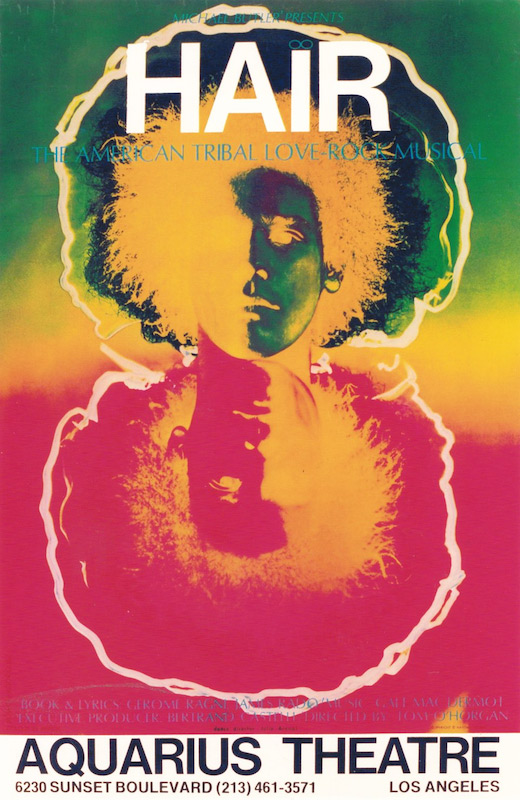
Did you know that the full name of the musical is “Hair: The American Tribal Love-Rock Musical”
I bought the original cast album of “Hair” when I was in high school, about 1978, and practically wore out the grooves. I never saw the show on stage, but these songs are indelibly etched in my aural hard drive. I was reasonably eclectic in my musical tastes for a high schooler, listening to (and singing) classical, gospel and folk songs from around the world and—because I attended public school in Hyde Park—a rich mixture of soul, R&B and early funk. I was then and still am amazed that such a variety of songs could come from a single musical brain. How can one white dude write the lovely ballad “Good Morning Starshine” and also “White Boys,” “Aquarius,” and “Be-In”? I guess that MacDermot’s time in South Africa and his work as a gigging jazz musician gave him both stylistic flexibility and the ability to adapt quickly. Each song has integrity and is self-contained, while also moving to the next song in a way that seems effortless.
“Hair” not only changed the face of the American musical theater, but also proved that a Broadway musical could be a powerful form of protest and free speech, exploring the ideas of rebellion and challenging the political, social and theatrical norms the creators, Gerome Ragni, James Rado and Galt MacDermot, observed around them.
I’m thankful for such an eclectic and productive musician who left such a rich and varied musical legacy. Let the sunshine in!
Jonathan Miller is co-founder and artistic director of the Sounds Good Choir organization.
Main Sources:
https://www.thecanadianencyclopedia.ca/en/article/galt-macdermot-emc
https://www.thecanadianencyclopedia.ca/en/article/my-fur-lady-emc
https://www.nytimes.com/2018/12/18/obituaries/galt-macdermot-dead.html
https://www.nj.com/entertainment/arts/2008/07/40_years_of_hair.html
https://www.galtmacdermot.com/
as well as Wikipedia
I wore out my original cast album long before you did!
Thanks for sharing this.
Thank you for sharing your thoughts on MacDermot. I am surprised that he is not a hippie! Love Hair…great songs, great memories!
Fascinating history. Thanks, Jonathan.