
I’m the director of the Good Memories Choir, a program of Sounds Good Choir, created for people with dementia and their care partners to sing together. Eleanor, 79, is a caregiver for her older sister. They had been singing with Good Memories for a year before she said something that has stayed with me. After rehearsal one day she lingered, having a final nibble at the snack table. “You know what I didn’t expect at this point in my life?” she told me. “To feel like I belong somewhere new.” She paused. “I thought that part was over.”
And what Eleanor had stumbled into, without quite naming it, is something researchers have been documenting for years: namely that aging, for all its genuine losses, carries with it some remarkable and largely unheralded gifts.
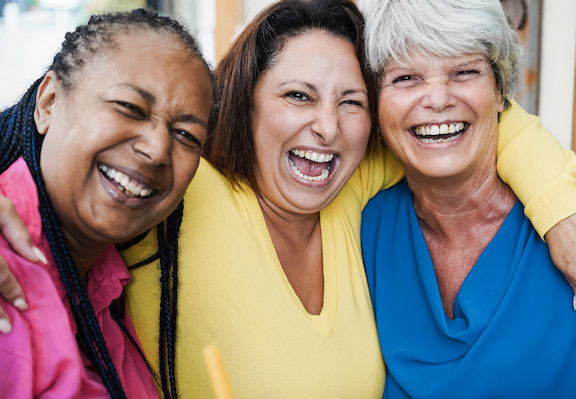
Laura Carstensen’s research suggests that something more intentional is often at work: people aren’t losing their social world so much as editing it. The relationships that are emotionally meaningful are preserved and deepened; the peripheral ones are quietly released.
Much of this research traces back to Stanford psychologist Laura Carstensen, whose socioemotional selectivity theory has shaped the field since the early 1990s. Her central insight is deceptively simple: our sense of time shapes our priorities. When we’re young and time seems to stretch indefinitely ahead, we pursue broad goals—new skills, wide networks, novel experiences. But as we grow older, and as we become more keenly aware that time is finite, something shifts. We invest more deliberately in what matters most. We trade breadth for depth, stimulation for meaning. We do fewer things and do them with greater attention and wonder. This isn’t resignation. It’s reorientation. And the research suggests it produces real psychological rewards. Gallup polling data, drawn from large national samples, consistently finds lower rates of worry, anger, sadness, and stress among older adults as compared with younger people. Carstensen’s own work has found that even during the COVID-19 pandemic—which threatened older adults’ health far more acutely—older people reported more positive and fewer negative emotions than their younger counterparts. As she noted in a 2021 review in the Annual Review of Psychology, the emotional benefits of aging are among the most reliably documented findings in lifespan psychology.
Part of what drives this shift is a phenomenon researchers call the positivity effect—a measurable change in what we notice, dwell on, and remember. Younger adults tend to pay more attention to negative or threatening information, a bias that makes evolutionary sense. Older adults show the opposite pattern: they are more likely to attend to and recall positive information, and less likely to ruminate on the negative. Crucially, this doesn’t mean older adults are wearing rose-colored glasses or avoiding hard realities. The effect shows up in automatic, subconscious tasks that participants can’t consciously control. And when something genuinely important and negative demands attention, older adults respond to it just fine. The positivity effect seems to operate more like a default setting: when there’s no compelling reason to dwell on the dark, the mind simply doesn’t linger there. Research published in 2024 in Frontiers in Behavioral Neuroscience found that this shift begins quietly in middle age—decades before most people would think of themselves as “old.”
Then there are relationships. One of the most visible social changes of aging—a smaller circle—is often misread as a symptom of loss. Friends die or move away. Retirement ends daily collegiality. The calendar gets quieter. But Carstensen’s research suggest that something more intentional is often at work: people aren’t losing their social world so much as editing it. The relationships that are emotionally meaningful are preserved and deepened; the peripheral ones are quietly released. The result, paradoxically, is often greater relationship satisfaction—not less. Studies find that marital satisfaction tends to improve with age, even among couples who were unhappily married in earlier life. Older adults also show more empathy in social interactions and are more willing to forgive. And many report a capacity they didn’t have at 40: the ability to hold the full, complicated reality of another person—their flaws alongside their gifts—without needing to resolve the tension. Researchers have a term for a related phenomenon: poignancy. It’s the ability to feel joy and sadness simultaneously—to be fully present at a grandchild’s birthday party while also being quietly aware of how precious and fleeting the moment is. Younger people tend to experience emotions as more discrete and separate. With age, many people find their inner lives becoming richer and more layered, more capable of holding life’s complexity without being destabilized by it. In many wisdom traditions, this is considered a mark of genuine maturity. The science, it seems, agrees.

It would be both dishonest and unkind, though, to leave the story there.
The emotional benefits described above are real—but they are not universal. They show up most reliably in older adults who maintain reasonable physical health, adequate financial security, and meaningful human connection. When those conditions are absent or seriously compromised, the picture looks quite different.
Chronic pain takes a real psychological toll. Financial insecurity introduces a persistent, grinding stress that erodes wellbeing in ways that are hard to overstate. Caregiving responsibilities—which fall disproportionately on older women—can consume the very time and energy that might otherwise be invested in the relationships and renewal that make aging rich. Cognitive decline, when it occurs, affects not just memory and thinking but the capacity for emotional regulation that underlies many of the positive changes described here.
These are not edge cases. They describe the daily reality of many older adults, particularly those navigating poverty, isolation, or serious illness. The research is honest about this: the emotional gifts of aging are, to a meaningful degree, shaped by circumstance. Which is one more reason why the conditions that support older adults—access to healthcare, economic security, community—are not just social welfare issues. They are, quite literally, emotional wellbeing issues.
For readers who are in those harder circumstances, or who love someone who is, the research isn’t a rebuke. It’s, perhaps, a map of what becomes possible—and a reminder of what’s worth working toward.
The story of aging that most of us carry was written largely by younger people looking ahead with apprehension. The research described here represents something different: decades of careful observation, much of it conducted with older adults as participants, that offers a more complete and more honest portrait.
That portrait includes real losses. It would be sentimental to pretend otherwise. But it also includes genuine gains—in stability, in the quality of what we notice, in the depth of our closest bonds, in the capacity to find meaning in what remains. Many older adults report these changes not with surprise, but with a quiet recognition: Yes. This is what I’ve become.
I wonder if that’s what I was hearing from Eleanor; she was embodying this paradox of aging as she and her sister experienced the warmth and welcome of this community that we call Good Memories.
Sandy Siegel Miller, Ph.D., is the co-founder of Sounds Good Choir, the largest no-audition choral organization in the Chicago area for older adults 55+, and the program director for the Good Memories Choir, a program for people with early-stage dementia and their care partners to sing together. Witnessing the powerful influence the choirs were having on the well-being of cognitively healthy older adults, she and co-founder and artistic director, Jonathan Miller, created the Good Memories program in 2018 to bring the same positive effect to those with memory loss. Since then, Sounds Good Choir has partnered with Northwestern University’s Mesalum Center for Cognitive Neurology and Alzheimer’s Disease on multiple studies to document the impact of choral singing as a proven intervention—both in the treatment of dementia and in protecting against the progression of cognitive impairment—for cognitively healthy older adults and those in the early stage of dementia. Their most recent study was published in April 2025 in the Journal of Alzheimer’s Disease. Good Memories, a weekly, 15-week choral program, is adding new choirs in 2026 on the South Side of Chicago and its western suburbs.
What an affirming article, thank you.
Thank you Sandy for a well done article. I resonate personally with the emotional gifts of aging especially regarding both the editing and the deepening of relationships. I’m passing your excellent article on to others.