
In the first of a three-part series, co-founders Jonathan Miller and Sandy Siegel Miller shared their story of developing the vision to create new Good Memories choirs, including a location on the South Side. In Part II, they tell you more about how the South Side choir came to be, covering the period from January to July 2026.
How fortunate we were that our lead consultant, Treasyri Williams Wood, has been down this path before! We’ll start with a video (captioned, 6-1/2 minutes) about our work with Treasyri and the community-organizing model that we followed together. Click here or on the video to watch it and read on below for more details about our journey!
Creating a Structure for Success
Treasyri began our work together in January by creating a structure that included regular monthly check-ins with herself, Sandy, Lynn Clark, and Jon. The meetings were organized around an agenda with specific goals, including a review of goals from the previous month’s meeting and how we were tracking relative to those goals. It has been remarkable to see those monthly checklists, almost without fail, marked with “Done!” every time. That’s a sign of realistic, though ambitious, planning.
Can’t Do This Without a CAB!
The structure that Treasyri has had us follow also included creation of a community advisory board (“CAB”). The CAB was structured to be composed of representatives from six major sectors:
- Health Care/Public Health
- Advocacy organizations (e.g., SHARE Network, local Villages)
- People with memory issues and care partners
- Musicians and trusted people in the community
- Members of faith communities
- Sounds Good Choir leadership
The Community Advisory Board has its own mission statement and charter.
Core Mission
To provide community-centered guidance, cultural expertise, and lived experience perspectives that shape the development, implementation, and evaluation of Good Memories Choir’s expansion to Chicago’s south side, with particular focus on serving individuals living with dementia and their care partners.
Guiding Principles
- Community ownership: South side residents and stakeholders
- Cultural humility: Programs reflect the culture, values, and preferences of the communities served
- Authentic partnership: Institutional representatives collaborate as community members, not organizational spokespeople
- Lived experience: People living with dementia and care partners are essential voices, not tokens
- Health equity: Address barriers to access and center marginalized voices
This slide gives an overview of why the CAB is essential to our success.
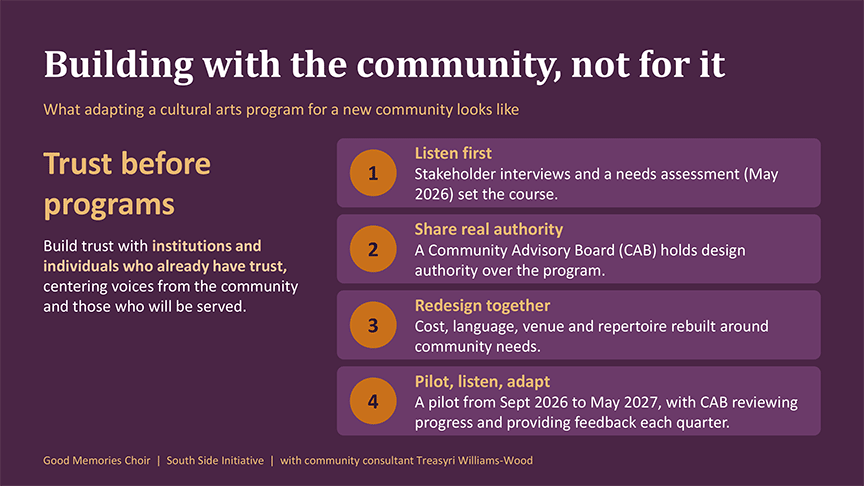
The South Side pilot goes through May 2027. However, Treasyri made clear that the commitment for CAB members would only be for one year, to get us through the Fall 2026 session of our pilot.
February found Treasyri working hard at recruiting for the CAB. By the end of the month, she had recruited ten people for the CAB—a strong start. Treasyri was focusing also on what she called Anchor Partners: at least one strong partner from each of three important institutions, namely health care, venue, and a community organization.
What Does the Community Actually Need?
Treasyri’s structure also includes producing a Community Needs Assessment. We identified approximately 20 people that Treasyri would interview. Because convening the CAB happened in parallel with starting to ask what the community needed, we started hearing important themes while Treasyri was in the middle of recruiting.
In March, we held our first quarterly CAB meeting, over Zoom. Our group discussion focused on the importance of culturally-responsive messaging, in particular addressing the situations that people on the South Side tend to face regarding cognitive issues. CAB members highlighted some unique challenges specific to the South Side, themes that were also coming up in early interviews:
- Community members’ relationship with the health-care system
- Later diagnosis of dementia than in the white population
- Family members being the ones primarily serving as care partners
- There is a greater stigma against talking about dementia in the Black community than in the white population.
The second main concern that arose from the CAB meeting was a recommendation that we change from a tuition-based financial model to a donation-based one, to remove cost as a barrier to participation.
The Needs Assessment was completed in May. Interviews with ten community stakeholders included people living with dementia, care partners, community health workers, community-based musicians, and local faith leaders. Findings were analyzed through the lens of the five social determinants of health (SDOH) domains: education access and quality, economic stability, social and community context, healthcare access and quality, and neighborhood and built environment.
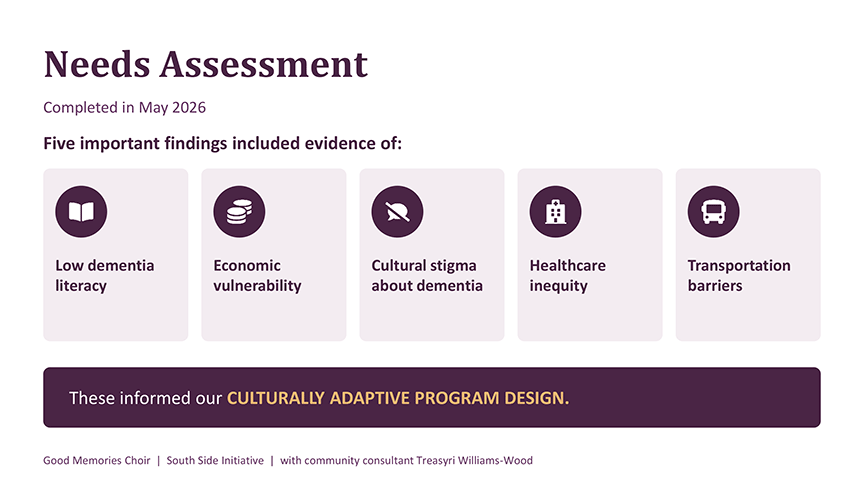
These five primary findings informed what became our Culturally-Adapted Program Design. It was becoming clear that our South Side Good Memories choir, if we were true to our intention to make it reflective of the community, would differ from our existing Gold Coast choir in some major ways.
At the second CAB meeting in June, which was held in person at the Hall Library branch of the Chicago Public Library in Bronzeville, Treasyri presented the findings of the Needs Assessment.
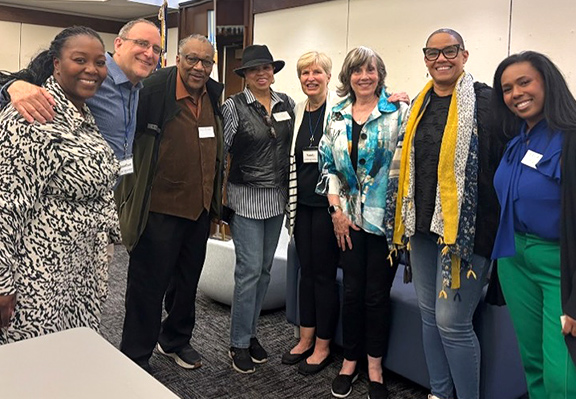
Some attendees from the June meeting of our CAB, at the Hall Library in Bronzeville: (L. to R.) Phyllis Timpo, Jonathan Miller, Bruce and Phyllis Rogers, Sandy Siegel Miller, Lynn Clark, Margaret Murphy-Webb, Treasyri Williams-Wood
The conversation at the Hall Library was remarkable. First, we had what we wanted in the CAB: representation from many important sectors of the community, people whose input is essential to the South Side choir. The impressive group included Margaret Murphy-Webb, founder and executive director—and lead vocalist—for the Southside Jazz Coalition. As the first slide above says, we were starting to build trust with the people whom the community trusts, and “Miss Margaret” is right up there. (More on her in the next post installment.)
After Treasyri presented the Needs Assessment, yet another need in the community emerged. Someone said, “You know, you’ve talked a lot about having this choir in Bronzeville. But Bronzeville is where everyone else is putting new resources these days. There’s all this new building going on, medical clinics moving in, and Bronzeville is going upscale. Is that really where we want to be? There’s a lot more to the South Side than that, and the further south you go, the fewer resources people have. We really need to think hard about that.” A number of others agreed that we were not necessarily going to do the best job for the people who really needed our choir if we were stuck on Bronzeville.
Phyllis Timpo from UChicago Medicine suggested that we talk to the Kroc Center in West Pullman, on the far South Side. This is not something that we had considered carefully before; and yet in the context of that conversation, it suddenly made more sense.
To Kroc or Not to Kroc?
By our July check-in, it was looking like the Kroc Center were interested in hosting us. However, after a few twists and turns during the month, it appeared a few days later that we might have to look elsewhere. We were also putting together the structure for conductor interviews and auditions; Jon had posted the job on LinkedIn and held phone interviews with the five most promising conductor candidates. A number of conductor candidates visited the Gold Coast Good Memories rehearsal in mid-July, and a number of others attended the Summer Rocks concert at Fourth Presbyterian where Good Memories and Sounds Good performed Beatles music together.
The next three challenges—which will be covered in our next installment in this series—were finalizing our conductor, recruiting a choir coordinator, and finding singers for this brand-new choir. We might call that last step “Miracle on 119th Street.” Stay tuned.
Heartfelt Thanks to our Community Advisory Board!
South Side Good Memories Choir 2026 CAB Members
- Phyllis Timpo, HAARC, University of Chicago
- Darby Morhardt, Mesulam Center, Northwestern University
- Karen Graham, RUSH *Update June 5th, 2026 replaced by Dr. Tarisha Washington, Rush Alzheimer’s Disease Center
- Penny Hill, Center for Better Aging at St. Bernard Hospital (Anchor Partner)
- Jenil Bennett, SHARE Network Representative (Anchor Partner)
- Tom Dietvorst, South Loop Village Representative
- Bruce Rogers, Person Living with Dementia/Musician
- Phyllis Rogers, Care Partner
- Margaret Murphy Webb, Southside Jazz Coalition
- Jinxiao Ruby Tan, Chinatown Memory Café
- Phil Bennett, Sage Collective Alzheimer’s Association, Illinois Chapter
- Lois Moore, Chicago Music Association Representative for the National Association of Negro Musicians (NANM)
- Dorothy Strang, Chicago Hyde Park Village
- Patricia Stokes, St. Thomas Episcopal Church
0 Comments