
The Road
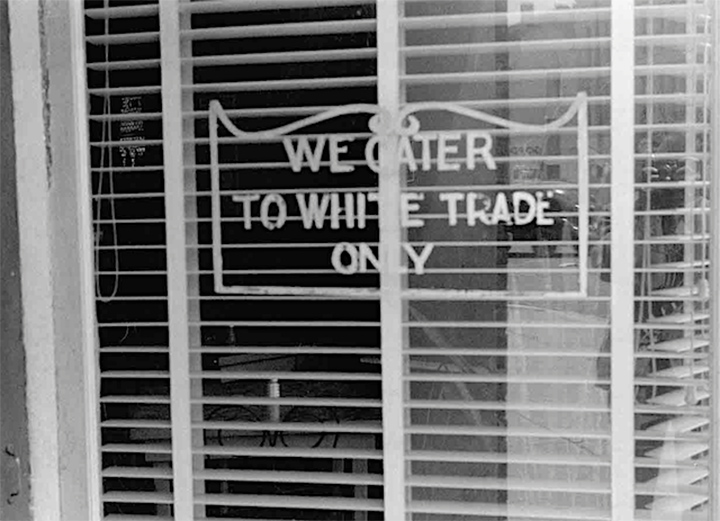
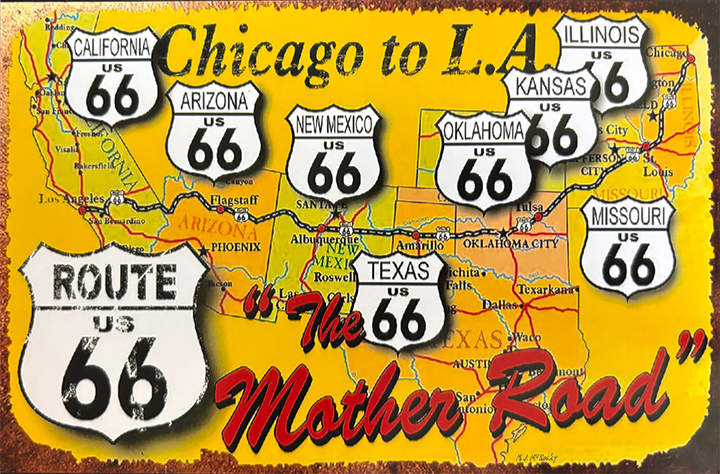
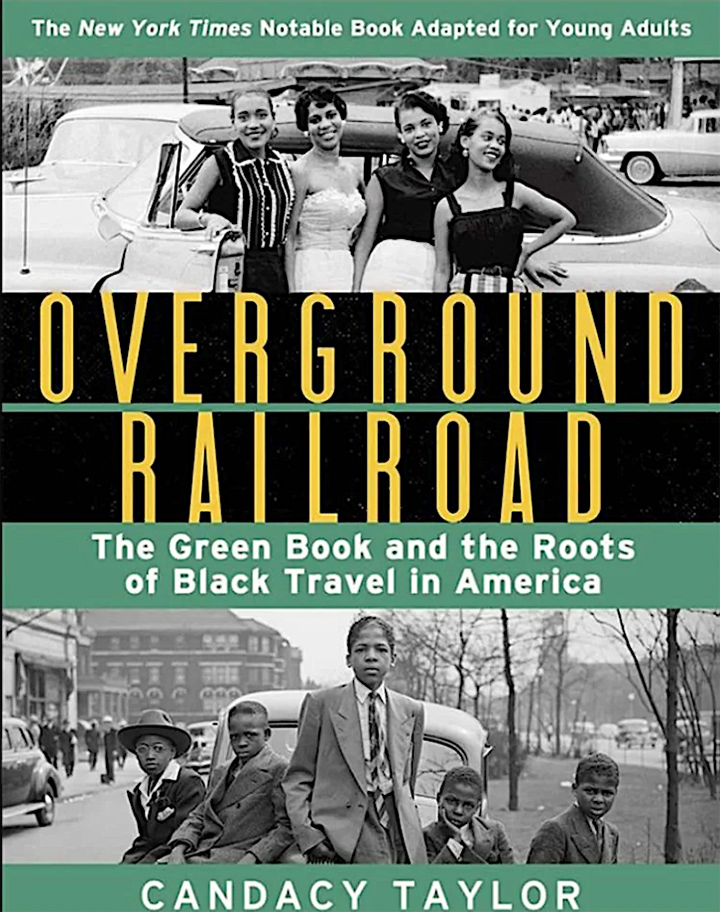
Route 66 was always much more than just a convenient route from point A to point B. Officially established on November 11, 1926, as part of America’s new numbered Federal highway system, “America’s Main Street” was the road that would finally connect the Midwest to the Pacific Coast and link large cities to small towns and far-flung rural communities. John Steinbeck called Route 66 the “Mother Road” in “The Grapes of Wrath” because it had guided so many thousands of impoverished families on their migration to California from the Dustbowls of the Midwest during the Great Depression. By the 1930s and 40s, Route 66 had come to symbolize the open road, family vacations, and the freedom of travel. But not for everyone. Route 66, or any open road, did not symbolize freedom for American Blacks. Candacy Taylor wrote in a 2016 article in The Atlantic that later formed part of her 2020 book, “Overground Railroad:”
“Just one year before construction on Route 66 began, the Chicago Tribune suggested in an editorial on August 29, 1925, that black people avoid recreational sites altogether:
‘We should be doing no service to the Negroes if we did not point out that to a very large section of the white population the presence of a Negro, however well behaved, among white bathers is an irritation. This may be a regrettable fact to the Negroes, but it is nevertheless a fact and must be reckoned with … [T]he Negroes could make a definite contribution to good race relationship by remaining away from beaches where their presence is resented.’”
Taylor continues:
“Not only were they shut out of pools and beaches, black Americans also couldn’t eat, sleep, or even get gas at most white-owned businesses. To avoid the humiliation of being turned away, they often traveled with portable toilets, bedding, gas cans, and ice coolers. Even Coca-Cola machines had White Customers Only printed on them. In 1930, 44 out of the 89 counties that lined Route 66 were all-white communities known as “sundown towns”—places that banned black people from entering city limits after dark. Some posted signs that read, “N——er, Don’t Let the Sun Set on You Here.”
The Green Book
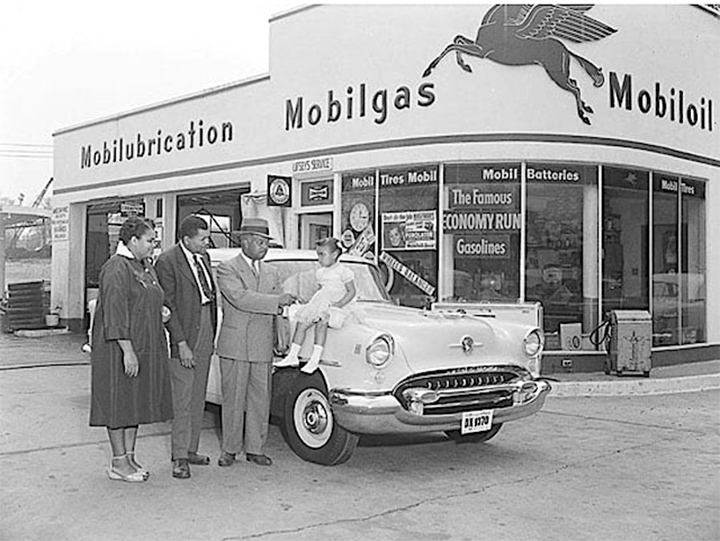
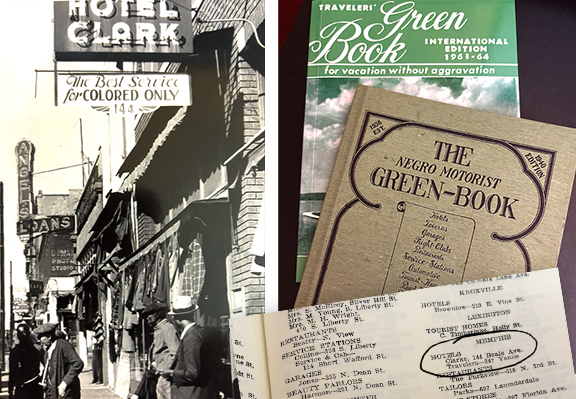
In 1936, Victor H. Green, a postal carrier in New York, published “The Negro Motorist Green-Book,” a guide to hotels and restaurants in New York that would serve Blacks for “a vacation without aggravation.” A growing middle class who had the means and desire to travel nonetheless still had to navigate a United States where Jim-Crow laws (official or not) determined where Blacks could sleep, eat, do business, shop for a pair of shoes, get a haircut or a suit tailored—all the things one might do if one were traveling on a vacation or for business. Almost immediately he began to extend the book’s coverage across the rest of the country. Initially sold for a quarter at Black-owned businesses and Esso stations (the only gas station that would sell to Blacks), Green also sold the book by mail order. Despite the Southern United States being labelled as the home of Jim-Crow laws, these existed all over the country. And sundown towns—all-white communities that warned Black people to leave before the sun went down—explicitly promised serious harm or death from signs and billboards at the town limits. In America from the 1930s through the 1960s, there were more than 10,000 sundown towns, and more than 150 in Illinois. Mitti Hicks notes, “The unofficial slogan in Anna, Illinois, a town along Route 66, was “Ain’t No N*G**** Allowed.” The town violently expelled its African American population and today the reputation still lingers over Anna’s 4,500 citizens.
Hicks continues, writing about the 1956 Green Book listings for Route 66:
“Start in Chicago and trace that same route. Count the hotels and restaurants where a Black family could safely rest their heads or sit down for a meal without being turned away, humiliated, or worse. Count the gas stations that would actually pump fuel into a Black motorist’s car… There are only four listed on the route itself in this edition. It’s worth noting that several Green Book listings existed in towns near the highway, but only four on the route itself. The four destinations listed for Black travelers in this [1956] version of the Green Book included the El Adobe Hotel in Needles, California; The White Rock Motel in Kingman, Arizona; the Amigo Motel & Café in Tucumcari, New Mexico; and the Casa Linda Hotel in Gallup, New Mexico.
Green passed away in 1960, four years shy of seeing his dream of equal rights achieved. Lyndon B. Johnson signed the American Civil Rights Bill on July 2, 1964; the last Green Book was published in 1964.
The Song
Nat King Cole’s song, “(Get Your Kicks On) Route 66,” was recorded in 1946 and went on to become the iconic hit. Ironically, while sitting in a restaurant that wouldn’t have served Nat King Cole because he was Black, Bobby Troup got the idea for the song that Cole would make famous. The first time Cole heard the song, its composer, Troup, had just arrived in California after travelling from the Midwest via Route 66. As he later told Cole, he and his wife had pulled over to have lunch at a Howard Johnson’s, when Troup said that he thought he should write a song about their trip. His wife quipped, “Get your kicks on Route 66!” A few days later, thanks to his forceful manager, Troup found himself singing his newly finished Route 66 song to Cole, who loved it and bought the song on the spot.
Author Mitti Hicks writes:
Coming just as postwar America was rediscovering leisure travel, the song was a big hit—and for many, a painful irony. Even with guidance from the Green Book used by many African American travelers in those days, it would have been deeply risky—and illegal in some places—for any Black man, Nat King Cole included, to eat and sleep on Route 66. This was a year before Jackie Robinson integrated baseball’s major leagues, two years before the U.S. Army was integrated.
How different the Troups’ trip would have been, not having to worry about where they could eat lunch, spend the night or stop to use the bathroom. Had Cole been with the Troups, he wouldn’t have been welcome in that Howard Johnson’s. How could he be certain? Because he had been traveling to different gigs and shows on roads for years and, like so many thousands of Black Americans, Cole no doubt had a Green Book of his own and knew one day he would need it.
The Singer
Ten years after he gave Route 66 its big musical kicks, Nat King Cole was in Birmingham, Alabama, in 1956, performing for an all-white audience at the Municipal Auditorium when six white men rushed the stage, attacked, and knocked him down, hurting his back.
He briefly returned to the stage and the remaining audience members gave him a 10-minute standing ovation. He thanked them and said he couldn’t continue to perform because he needed to see a doctor. According to the British paper, “The Guardian:”
“The six men were formally charged with assault with intent to murder him, but later the charge against four of them was changed to conspiracy to commit a misdemeanour. Later, police reported more than a hundred white men had planned to attack Cole and overpower Heath’s band. They said the affair had been planned four days before it took place. A total of 150 men from the Birmingham area and near-by towns were to have arrived at the auditorium, but the mob failed to show up.”
Cole didn’t return to the stage that night and he cancelled his three other appearances before returning to Chicago. Think about his trip back home: Did he drive all the way back from Alabama by himself, with others? Or did he take a cab to the airport? Where would he sleep if he drove back?
Shortly after the attack, Cole recorded his only overtly political song, “We Are Americans, Too.”
The Road
Route 66 is pure Americana: a kaleidoscope of everything that’s great and everything that’s not. Candacy Taylor writes:
Today, Route 66 has surrendered to a series of bypasses, causeways, and highways, but the path it traced is still troubled: “American Owned” signs line the old Route 66; they are code for “Not Owned by Immigrants.” In Noel, Missouri, Somali immigrants say they are not welcome at Kathy’s Kountry Kitchen, where even now servers wear T-shirts reading, “I got caught eating at the KKK.” Stories like these are why the rosy hue of Route 66 nostalgia leaves a bitter chill in the souls of black people.
If you’re interested, you can read Candacy Taylor’s entire 2016 Atlantic article, “The Roots of Route 66.”
One of the Green Book’s most unusual Route 66 sites was Murray’s Dude Ranch. This lost gem was billed as “The Only Negro Dude Ranch in the World”—which it very likely was. The 40-acre ranch was situated on the edge of the Mojave Desert, with Joshua, yucca, and mesquite trees dotting the landscape. A black couple, Nolie and Lela Murray, owned the property and offered black people traveling on Route 66 much-needed lodging and some good old-fashioned Western recreation. All manner of black and white celebrities visited, from Lena Horne and Joe Louis to Hedda Hopper and Clara Bow. Pearl Bailey ultimately bought the property in 1955 but sold it in the mid-1960s. Sadly, today there’s no physical evidence that Murray’s Dude Ranch ever existed.
Can’t wait for another season.
I have friends who remember family travels using the Green Book for their safety